Heat and technique
Pizza oven vs grill
A grill is already the hottest appliance most households own, and it is already outside. The reason it still is not a pizza oven comes down to one structural thing, and there are two ways to fix it for a fraction of the price of an oven.
The short answer
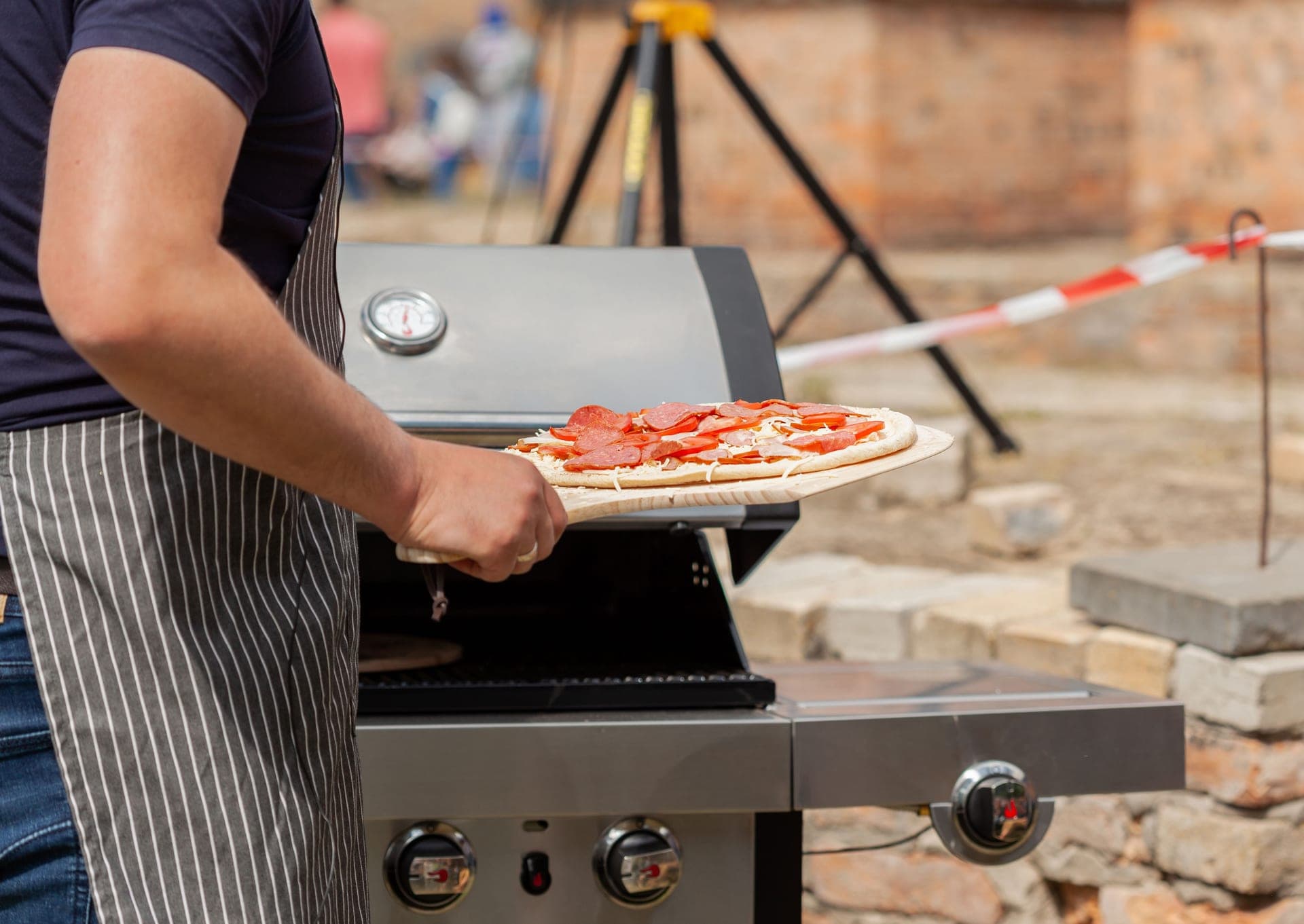
A grill can make genuinely good pizza and it cannot make Neapolitan pizza. With a stone and the lid down you are working at 600 to 800 F, against 500 to 550 F in a kitchen oven and 950 F in a dedicated pizza oven. That range is New York territory: a crisp base, a browned rim, a three-to-six-minute bake. What a grill is missing is not heat, it is a roof close enough to cook the top — and a stone alone does not supply one.
This is the cheapest honest experiment in the whole category, and it is the one worth running before you spend money on an appliance. If a stone on your grill turns out to be enough, you have saved several hundred dollars. If it turns out not to be, you now know exactly what you are buying and why.
The structural problem is the roof, not the fire
A pizza cooks from two directions at once. The floor conducts heat into the base while the roof radiates down onto the toppings, and a good pizza is the one where both finish at the same moment.
A pizza oven's roof is a few inches above the pizza and nearly as hot as the floor. A grill's lid is far away, made of thin metal, and a couple of hundred degrees cooler than the fire. So on a grill the base browns fast and the cheese lags, and the instinct — leave it longer — burns the base. It is the same mechanism behind why one side of a pizza burns, rotated ninety degrees.
That is the whole diagnosis. Everything below is either a way to build a roof or a way to accept that you do not have one.
Three routes, and what each publishes
| Route | Working temperature | Bake time | What you get |
|---|---|---|---|
| Kitchen oven with a steel | 500 to 550 F | 8 to 12 min | A better base than a tray, nothing like a pizza oven |
| Grill plus a bare stone | 600 to 700 F at the stone | 4 to 8 min, lid down | A crisp base, a pale top unless you close the lid and wait |
| Grill plus a conversion box | 600 to 800 F | 2 to 7 min | Crisp base and browned top, genuinely good New York style |
| Dedicated gas pizza oven | 950 F | 60 to 90 s | Leopard-spotted Neapolitan, and nothing else does it |
Published working temperatures. The grill figures are the makers' published ranges for grill-top conversions; the oven figure is what almost every gas pizza oven on this site publishes.
Two things are worth noticing in that table. The jump from a kitchen oven to a grill is large. The jump from a grill to a pizza oven is smaller in degrees and much larger in what the pizza looks like, because the last 150 F is where the dough skin starts to char rather than brown.
What a bare stone on a grill actually does
It solves half the problem for the smallest amount of money in this category, and it is the right first step for almost everyone.
The rules are narrower than in an oven, because a grill heats a stone from one side only and much harder. Indirect heat, never a burner directly under the stone, the stone goes on cold and comes up with the grill, and 30 to 45 minutes of preheat with the lid down before you launch anything. The material matters too — the grill stone page covers why one of the best-known stones on the market is rated by its own maker for 500 F, which is below what your grill will be doing.
What a conversion box adds
A grill-top pizza oven box is an enclosure with stone on five sides that sits on the grates. That puts hot stone above and beside the pizza as well as under it, which is the roof the grill does not have.
The published numbers back it up: BakerStone states 600 to 800 F inside its chamber with a 2-to-4-minute bake, and Cuisinart states up to 800 F with 5 to 7 minutes. Both are dramatically better on the top of the pizza than a bare stone, and both cost a fraction of an oven. The conversions page compares the four worth knowing about, including what to do if you own a griddle rather than a grill.
Quick picks
Ranked for fit, not for hype. Every figure below is the maker’s own published number, and “n/p” means they do not publish it — which is itself worth knowing. Tap a row for the full write-up, or go straight to the listing.
| # | Oven | Best for | Max pizza | Weight | Price |
|---|---|---|---|---|---|
| 1 | 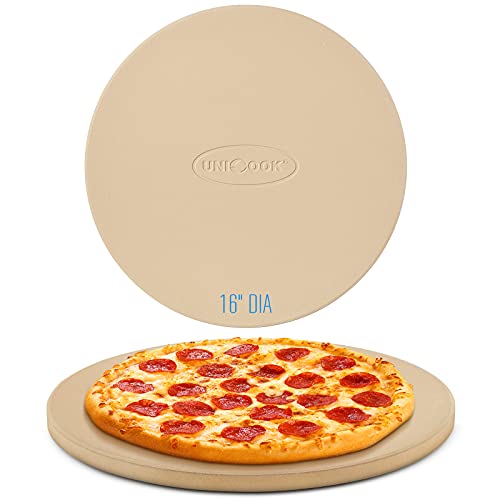 Unicook 16 in roundRound, 16 in across, 0.57 in thick and rated to 1450 F. | A kettle grill or a kamado | 14" | 7.4 lb | $47.48 · Check on Amazon-5% |
| 2 |  BakerStone boxA five-sided stone chamber that sits on the grates and turns a grill's one-directional heat into something closer to... | A three-burner gas grill you already own | 12" | n/p | $149.99 · Check on Amazon-12% |
| 3 |  Gozney Arc Lite26.4 lb and 16.9 in wide, with 5.9 in of internal height. | The lightest real oven here | 12" | 26.4 lb | $399.99 · Check on Amazon |
| 4 |  Ooni Koda 16Still the most sensible first gas oven anyone buys. | The default first oven | 16" | 40.1 lb | $498.00 · Check on Amazon-23% |
Max pizza and weight are the makers’ published figures, sourced on each write-up below. Neither is a measurement we took, and no column here is a score — we have not cooked on these ovens and will not pretend otherwise.
Top pick · A kettle grill or a kamado
Unicook 16 in Round Cordierite Pizza Stone for Oven and Grill
Unicook · Accessory
Round, 16 in across, 0.57 in thick and rated to 1450 F. Unicook is the only maker in this group that publishes all four of those numbers, and the 1450 F rating is the one that matters over live fire.
Published specification
- Size
- 16 in round
- Thickness
- 0.57 in (14.5 mm)
- Weight
- 7.4 lb
- Material
- Cordierite, kiln-sintered
- Heat rating
- 1,450 F (787 C)
- Included
- Dough scraper
What it does well
- Rated to 1,450 F, which is roughly double what a covered grill reaches — the margin is the point, because a grill heats a stone from one side
- Round is the right shape for a kettle or a kamado, where a rectangle leaves the corners over the gap
- 0.57 in and 7.4 lb is real stored heat, and a grill's floor gives you none of its own
- Unicook publishes size, thickness, weight and heat rating. Most of this category publishes one of the four
What you give up
- 16 in round wastes the corners of a domestic oven rack, where a rectangular stone uses the space better
- Cordierite is thermal-shock sensitive: it goes on a cold grill and comes up with it, and it never meets a cold surface hot
- No handles, and 7.4 lb of hot stone is awkward to move — plan to leave it in place until the grill is cold
Buy it if
A kettle, kamado or gas grill owner who wants the widest round stone that still fits.
Skip it if
A rectangular pellet-grill grate, where the corners do nothing.
Pick 2 · A three-burner gas grill you already own
BakerStone Original Series Grill Top Pizza Oven Box
BakerStone · Accessory
A five-sided stone chamber that sits on the grates and turns a grill's one-directional heat into something closer to an oven. BakerStone publishes the chamber dimensions, which is how you know a 12 in pizza fits and a 14 in one does not.
Published specification
- Outer size
- 22.8 x 16.3 x 6.3 in
- Baking chamber
- 14.9 x 13.8 x 3 in
- Chamber
- Five-sided stone
- Published temperature
- 600 to 800 F inside
- Bake time
- 2 to 4 minutes, per BakerStone
- Included
- Wood pizza peel, turning peel
- Fits
- Most three-burner or larger gas grills, larger charcoal grills
What it does well
- The five-sided stone chamber is the whole idea: a grill gives you heat from below only, and this puts stone on the sides and the roof as well
- Publishes its baking chamber, 14.9 x 13.8 x 3 in. Nothing else in this category tells you how big a pizza actually fits
- 600 to 800 F is a genuine jump over the 500 to 550 F a kitchen oven tops out at
- Comes with both a launching peel and a turning peel, so it is usable out of the box
What you give up
- A 3 in chamber height is low, and a tall-rimmed or heavily loaded pizza will touch the roof stone
- It borrows your grill, so the grill is unavailable for anything else while the pizza cooks, and the box has to come off before you grill again
- Still 150 F short of the 950 F a dedicated gas oven publishes — this is a New York bake, not a Neapolitan one
- Needs a three-burner grill. A two-burner will not hold the box's published temperature range
Buy it if
Someone with a good gas grill who is not ready to buy a second appliance.
Skip it if
Anyone chasing a 60-second Neapolitan bake, or anyone with a two-burner grill.
Where these numbers came from
Pick 3 · The lightest real oven here
Gozney Arc Lite Propane Outdoor Pizza Oven
Gozney · Propane
26.4 lb and 16.9 in wide, with 5.9 in of internal height. Gozney thinned the stone to 0.5 in to get there, which is the trade you are actually making.
Published specification
- Max temperature
- 950 F
- External size
- W 16.9" x D 18.9" x H 11.7"
- Internal size
- W 12.8" x D 14.0" x H 5.9"
- Weight
- 26.4 lb (12 kg)
- Stone
- Removable 0.5 in (12 mm) cordierite
- Max pizza
- 12 in
- Control
- Gas control dial; no digital display
What it does well
- The lightest oven in this registry by a clear margin — it is the one that actually goes in a car trunk
- 5.9 in of internal height is more than most 12 in ovens give you
- Keeps the Gozney lateral-flame layout at the entry price
What you give up
- 0.5 in stone stores noticeably less heat than the 0.8 in floors in the Arc and Arc XL, so the recovery pause between pizzas comes back
- 12 in maximum, and a 12.8 in chamber — very little turning room
- No digital gauge, so an infrared thermometer stops being optional
Buy it if
Balconies, campsites, and anyone whose oven has to be carried and stored each time.
Skip it if
Back-to-back cooking for a group.
Where these numbers came from
Pick 4 · The default first oven
Ooni Koda 16 Propane Gas Pizza Oven
Ooni · Propane
Still the most sensible first gas oven anyone buys. 16 inches is the size where a 12-inch pizza stops feeling like a tight squeeze, and at 40 lb one person can carry it.
Published specification
- Max temperature
- 950 F (500 C), reached in about 20 minutes
- Stone
- 16 in cordierite, 0.6 in thick
- External size
- 25" L x 23.2" W x 14.7" H
- Weight
- 40.1 lb unboxed
- Fuel
- Propane, or a separate natural-gas version for a gas line
- Warranty
- 1 year standard, 5 years on registration with Ooni
- Gas input
- Ooni does not publish a BTU input rating for the Koda line
What it does well
- The 16 in stone is the real argument for this model over the 12 in ovens — a 12 in pizza sits inside it with room to turn, which is what actually stops a burnt edge
- One-piece body with folding legs: no assembly, and it is the largest oven here a single person carries comfortably
- There is a natural-gas variant, so a household with a gas line can stop buying cylinders entirely — rare in this category
What you give up
- 0.6 in stone stores less heat than the 0.8 in floors on the newer Koda 2 Pro and the Gozney Arc, so back-to-back bakes need a longer recovery pause
- Single burner across the back: no dual-zone control, so everything cooks at one temperature
- No door and no glass, so the heat you lose between launches is heat you re-earn with the flame
Buy it if
Someone buying their first serious outdoor oven who wants 16 in capacity and does not want to think about fuel beyond turning a dial.
Skip it if
Anyone who wants wood flavor, and anyone cooking two different things at once — that is the Koda 2 Pro or the Karu.
Where these numbers came from
What a grill will never do
Neapolitan pizza is defined by a 60-to-90-second bake at around 900 F, and everything characteristic about it — the puffed rim, the leopard spotting, the soft center — is a consequence of that speed. No grill publishes 900 F under a lid, and no conversion box here claims more than 800 F.
That is not a small gap dressed up as a large one. It is the reason dedicated ovens exist, and it is the honest version of the argument in are pizza ovens worth it. If Neapolitan is what you are picturing when you imagine making pizza at home, a grill will not get you there and no accessory will change that.
The costs a grill route does carry
- Occupancy. While the box or the stone is on the grates, the grill is a pizza oven. You cannot grill anything alongside, and the box has to come off hot or you wait for the grill to cool.
- Fuel. Thirty to forty-five minutes of preheat at full output, every time, before the first pizza. That is a real amount of propane or charcoal, and it does not scale down for one pizza.
- Wear. Running a grill at its ceiling for an hour a session accelerates wear on grates, paint and ignition.
- Burner count. BakerStone specifies three burners or more. A two-burner grill will not hold the published range under a box that size.
Which route is yours
- You want to find out whether you care about this at all — a stone on the grill you already own. It is the cheapest real test available and the answer arrives in one evening.
- You want good pizza a few times a summer and already own a three-burner grill — a conversion box. New York style at 600 to 800 F, for a fraction of an oven, using an appliance that already has a home outdoors.
- You want Neapolitan, or you want pizza on a weeknight without a 45-minute preheat — a dedicated oven. The budget roundup is where that starts and how to choose is the order to decide in.
- You have no outdoor space at all — neither of these. Indoor electric is the route, at 700 to 850 F.
How these picks were made
We did not cook on these ovens. Every figure on this page is the maker’s or the listing’s published specification, cited on each write-up so you can check it in one click. The ranking comes from matching those published capabilities to a stated use case — space, pizza size, fuel, and how many pizzas you cook in a row. Where a maker does not publish a number, we say so instead of estimating one.
The full version of that argument, including what we deliberately do not claim, is on our methodology page.
Questions people actually ask
+Can you make pizza on a barbecue grill?
+Is a pizza oven better than a grill for pizza?
+How hot does a grill get for pizza?
+Do you need a pizza stone to make pizza on a grill?
+Should I buy a pizza oven or use my grill?
Sources for this page