Peels, stones and tools
The best pizza stones for a grill, kamado or smoker
A grill heats a stone from one side only, and it heats it harder than a kitchen oven ever will. That changes which stone you buy, and it rules out one of the best-selling ones entirely.
The short answer
Buy cordierite and check the published heat rating before anything else. The best all-round choice is the Unicook 16 in round — 0.57 in thick, 7.4 lb, rated to 1,450 F, and the only stone here that publishes all four of size, thickness, weight and rating. Round beats rectangular on a kettle or a kamado; rectangular wins on a pellet grill. And the one widely sold stone to avoid on a grill is the clay one whose maker caps it at 500 F.
Searching for a pizza stone for a grill returns a wall of near-identical listings, most of them the same shape and most of them saying "for oven and grill" whether or not the manufacturer agrees. Two facts sort them out, and both are published figures rather than opinions.
A grill is a harder place for a stone than an oven
A domestic oven surrounds a stone with air at 500 to 550 F. Every face of the stone comes up at roughly the same rate, and nothing in the oven is hotter than that air.
A grill does the opposite. Burners or coals sit directly under the grate, radiating at temperatures far above the air in the chamber, and they hit the underside of the stone while the top is still cool. That is a steeper gradient across the thickness of a brittle ceramic slab than an oven ever produces, and it is why the rating and the material matter more here than they do in a kitchen.
It is also why the published temperature of the appliance is not the number to compare against. BakerStone publishes 600 to 800 F inside its grill-top chamber; Cuisinart publishes up to 800 F for its own. The stone sitting on the grate below those numbers is taking more than 800 F from underneath.
Cordierite and clay are not interchangeable
Cordierite is a synthetic ceramic chosen specifically for a low coefficient of thermal expansion — it changes size very little as it heats, which is what stops it cracking when one face is much hotter than the other. Kiln furniture is made of it. So are the floors of almost every pizza oven on this site.
Clay stones are cheaper to make, work perfectly well in a 500 F oven, and are the ones that crack. The published ratings tell the story without any interpretation from us:
| Stone | Material | Published rating | Thickness |
|---|---|---|---|
| Unicook 16 in round | Cordierite | 1,450 F | 0.57 in |
| VEVOR 15 in round | Cordierite | 1,450 F | 0.67 in |
| Unicook 15 x 12 in rectangular | Cordierite | not published | not published |
| Hans Grill 15 in round | Cordierite | 1,112 F | not published |
| Old Stone 16 in round | Lead-free clay | 500 F, in a home oven | not published |
Published heat ratings, from each maker's own product page. Blank means the maker does not publish a figure.
Round or rectangular is decided by your grill, not by your pizza
This is the second decision and it is purely geometric.
- Kettle grills and kamados are round. A rectangular stone puts its corners over the edge of the charcoal grate or hard against the wall, which blocks the airflow that carries heat over the top of the pizza. A round stone two or three inches narrower than the grate lets air past on every side.
- Pellet grills, gas grills and offset smokers are rectangular. Here a round stone wastes most of a long grate, and a rectangle uses it. A Traeger or a Pit Boss barrel is the clearest case.
- Measure the grate, then subtract. You want a gap all the way around for convection. A 16 in stone belongs on a 22 in kettle, not an 18 in one.
Quick picks
Ranked for fit, not for hype. Every figure below is the maker’s own published number, and “n/p” means they do not publish it — which is itself worth knowing. Tap a row for the full write-up, or go straight to the listing.
| # | Oven | Best for | Max pizza | Weight | Price |
|---|---|---|---|---|---|
| 1 | 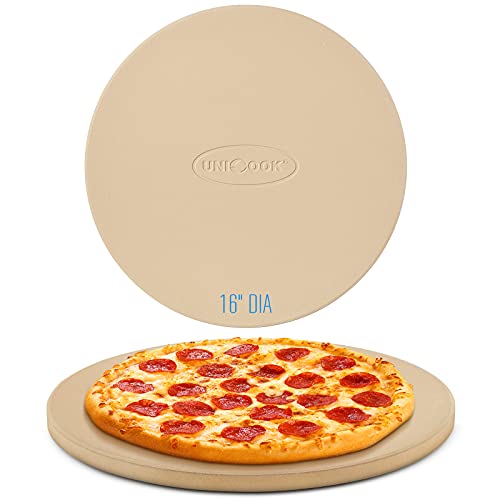 Unicook 16 in roundRound, 16 in across, 0.57 in thick and rated to 1450 F. | A kettle grill or a kamado | 14" | 7.4 lb | $47.48 · Check on Amazon-5% |
| 2 | 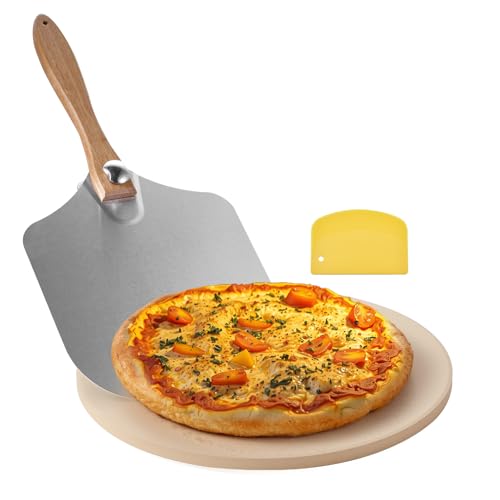 VEVOR 15 in stone0.67 in of cordierite rated to 1450 F. | A thicker replacement floor | 14" | n/p | $38.90 · Check on Amazon |
| 3 |  Hans Grill 15 in round15 in of cordierite rated to 1,112 F, sold with a wooden peel. | Arriving with a peel already in the box | 13" | n/p | $49.99 · Check on Amazon-17% |
| 4 | 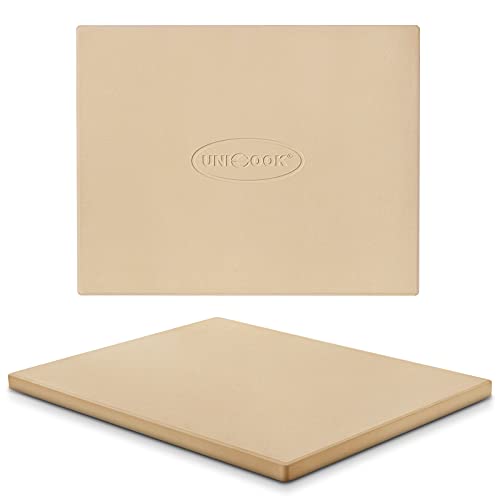 Unicook cordierite stone6.8 lb of cordierite, rectangular so it uses the whole rack. | The kitchen oven you already own | 12" | 6.8 lb | $29.99 · Check on Amazon-9% |
Max pizza and weight are the makers’ published figures, sourced on each write-up below. Neither is a measurement we took, and no column here is a score — we have not cooked on these ovens and will not pretend otherwise.
Top pick · A kettle grill or a kamado
Unicook 16 in Round Cordierite Pizza Stone for Oven and Grill
Unicook · Accessory
Round, 16 in across, 0.57 in thick and rated to 1450 F. Unicook is the only maker in this group that publishes all four of those numbers, and the 1450 F rating is the one that matters over live fire.
Published specification
- Size
- 16 in round
- Thickness
- 0.57 in (14.5 mm)
- Weight
- 7.4 lb
- Material
- Cordierite, kiln-sintered
- Heat rating
- 1,450 F (787 C)
- Included
- Dough scraper
What it does well
- Rated to 1,450 F, which is roughly double what a covered grill reaches — the margin is the point, because a grill heats a stone from one side
- Round is the right shape for a kettle or a kamado, where a rectangle leaves the corners over the gap
- 0.57 in and 7.4 lb is real stored heat, and a grill's floor gives you none of its own
- Unicook publishes size, thickness, weight and heat rating. Most of this category publishes one of the four
What you give up
- 16 in round wastes the corners of a domestic oven rack, where a rectangular stone uses the space better
- Cordierite is thermal-shock sensitive: it goes on a cold grill and comes up with it, and it never meets a cold surface hot
- No handles, and 7.4 lb of hot stone is awkward to move — plan to leave it in place until the grill is cold
Buy it if
A kettle, kamado or gas grill owner who wants the widest round stone that still fits.
Skip it if
A rectangular pellet-grill grate, where the corners do nothing.
Pick 2 · A thicker replacement floor
VEVOR 15 in Round Cordierite Baking Stone
VEVOR · Accessory
0.67 in of cordierite rated to 1450 F. Thicker than the 0.4 to 0.6 in floors in several ovens on this site, which is the specification that most affects recovery between pizzas.
Published specification
- Size
- 15 in round
- Thickness
- 0.67 in
- Heat rating
- 1450 F
- Included
- Metal peel and scraper
What it does well
- 0.67 in stores meaningfully more heat than a 0.4 in floor, and stored floor heat is what cooks the base
- 1450 F rating is well clear of any oven here
- Cheap enough to be the sacrificial floor you crack instead of the one that came with the oven
What you give up
- Round, so it wastes rack space in a domestic oven where rectangular would not
- A thicker stone takes longer to preheat — you trade recovery time for warm-up time
- Check your oven's own floor recess before assuming a 15 in round drops in
Buy it if
Replacing a cracked stone, or thickening a thin factory floor.
Skip it if
A domestic oven, where a rectangular stone or a steel uses the space better.
Where these numbers came from
Pick 3 · Arriving with a peel already in the box
Hans Grill Circular Pizza Stone, 15 in Cordierite with Wooden Peel
Hans Grill · Accessory
15 in of cordierite rated to 1,112 F, sold with a wooden peel. The peel is the reason to pick it: a stone without one is half a purchase, and buying both separately costs more.
Published specification
- Size
- 15 in round (38 cm)
- Material
- Cordierite
- Heat rating
- 1,112 F (600 C)
- Thickness
- Not published
- Weight
- Not published
- Included
- Wooden pizza peel
What it does well
- 1,112 F is comfortably above anything a covered grill will do, so the rating is not the limiting factor
- The wooden peel in the box is the accessory people forget, and wood releases raw dough better than metal
- 15 in round drops into most 18 to 22 in kettles with air still moving round the edge
What you give up
- Publishes neither thickness nor weight, which are the two numbers that decide how many pizzas in a row it will carry
- 1,112 F is the lowest rating of the stones here — fine for a grill, and less margin than the 1,450 F cordierite if you later move it into a real pizza oven
- A wooden peel cannot be left in a hot chamber and must be kept dry, unlike the metal one you would eventually want for turning
Buy it if
Someone buying their first stone who does not already own a peel.
Skip it if
Anyone who wants the published thickness before they buy.
Pick 4 · The kitchen oven you already own
Unicook 15 x 12 in Rectangular Cordierite Pizza Stone
Unicook · Accessory
6.8 lb of cordierite, rectangular so it uses the whole rack. For anyone not ready to buy an oven, this plus a hot domestic oven is the cheapest real improvement available.
Published specification
- Size
- 15 x 12 in rectangular
- Weight
- 6.8 lb
- Material
- Cordierite
- Included
- Dough scraper
What it does well
- Rectangular beats round in a domestic oven — a round stone wastes the corners of a rack
- Cordierite is porous, so it pulls moisture out of the base, which is exactly the failure mode of a domestic-oven pizza
- 6.8 lb of stored heat is the difference between a pale base and a browned one
What you give up
- A domestic oven caps out around 500 to 550 F, so no stone makes it a pizza oven. See why oven temperature is the whole game
- Cordierite is thermally shock-sensitive: it goes in a cold oven and heats with it, never onto a hot one
- Needs a long preheat — 45 minutes to an hour to be genuinely useful
Buy it if
Anyone deciding whether they care enough about pizza to buy an oven.
Skip it if
Someone who already owns a 950 F oven with a stone in it.
Where these numbers came from
Thickness is stored heat, and a grill gives you none of its own
In a pizza oven the floor is part of the appliance and it is already hot. On a grill the stone is the only thermal mass in the system. Everything the base of your pizza receives came out of that slab, and when it is gone you wait.
That makes thickness the specification to buy on if you are cooking more than one pizza — the same argument the site makes about stone thickness inside a pizza oven, only more so. The 0.67 in VEVOR stores meaningfully more than the 0.57 in Unicook; both store far more than a thin decorative round.
The trade is preheat. On a grill you are looking at 30 to 45 minutes with the lid down before a thick stone is genuinely ready, which is longer than most people give it and is the single most common reason a grill pizza comes out pale underneath.
What a stone on a grill will and will not do
It will give you a browned, crisp base at 600 to 800 F, which is a real improvement on a domestic oven and enough for New York style. It will not give you a 60-to-90-second Neapolitan bake, because the top of the pizza is being cooked by air at grill temperature rather than by a 900 F roof.
The fix for that is either a lid kept firmly down, or an enclosure — which is the argument for a grill-top pizza oven box rather than a bare stone. If you want to know whether the whole exercise is worth it before you spend anything, pizza oven vs grill is the honest version of that comparison.
Four rules that prevent a cracked stone
- It goes on cold and comes up with the grill. Never place a stone on a hot grate. That is thermal shock in its purest form.
- Indirect heat, not direct. On a gas grill light the outer burners and leave the one under the stone off; on charcoal bank the coals to the sides. Flame licking a stone is a crack.
- Never soap and never a deliberate soak. Cordierite is porous. It absorbs water, and trapped water turns to steam on the next heat-up. The maintenance page has the full routine, and a scraper and brush is all the cleaning any of these need.
- Let it cool in place. A hot stone lifted onto a cold worktop cracks for exactly the same reason a cold stone on a hot grate does.
How these picks were made
We did not cook on these ovens. Every figure on this page is the maker’s or the listing’s published specification, cited on each write-up so you can check it in one click. The ranking comes from matching those published capabilities to a stated use case — space, pizza size, fuel, and how many pizzas you cook in a row. Where a maker does not publish a number, we say so instead of estimating one.
The full version of that argument, including what we deliberately do not claim, is on our methodology page.
Questions people actually ask
+Can you put any pizza stone on a grill?
+What temperature should a grill be for pizza on a stone?
+Do you need a pizza stone on a pellet grill or smoker?
+Should you use a pizza steel on a grill instead?
+How big a stone fits a 22 inch kettle?
Sources for this page
- Unicook — 16 in round pizza stone: cordierite, 0.57 in thick, 7.4 lb, heat resistant to 1,450 F
- Hans Grill — circular pizza stone: cordierite, 15 in, heat resistant to 1,112 F (600 C)
- Old Stone — 16 in round pizza stone, retailer page carrying the maker's guidance of up to 500 degrees in a standard home oven
- BakerStone — Original Series grill top pizza oven box: 600 to 800 F published working range