Peels, stones and tools
The best infrared thermometers for a pizza oven
One specification decides this and it is not accuracy. A thermometer that stops at 716 F cannot tell you anything about a 900 F stone, and that is the most common mis-purchase in this whole category.
The short answer
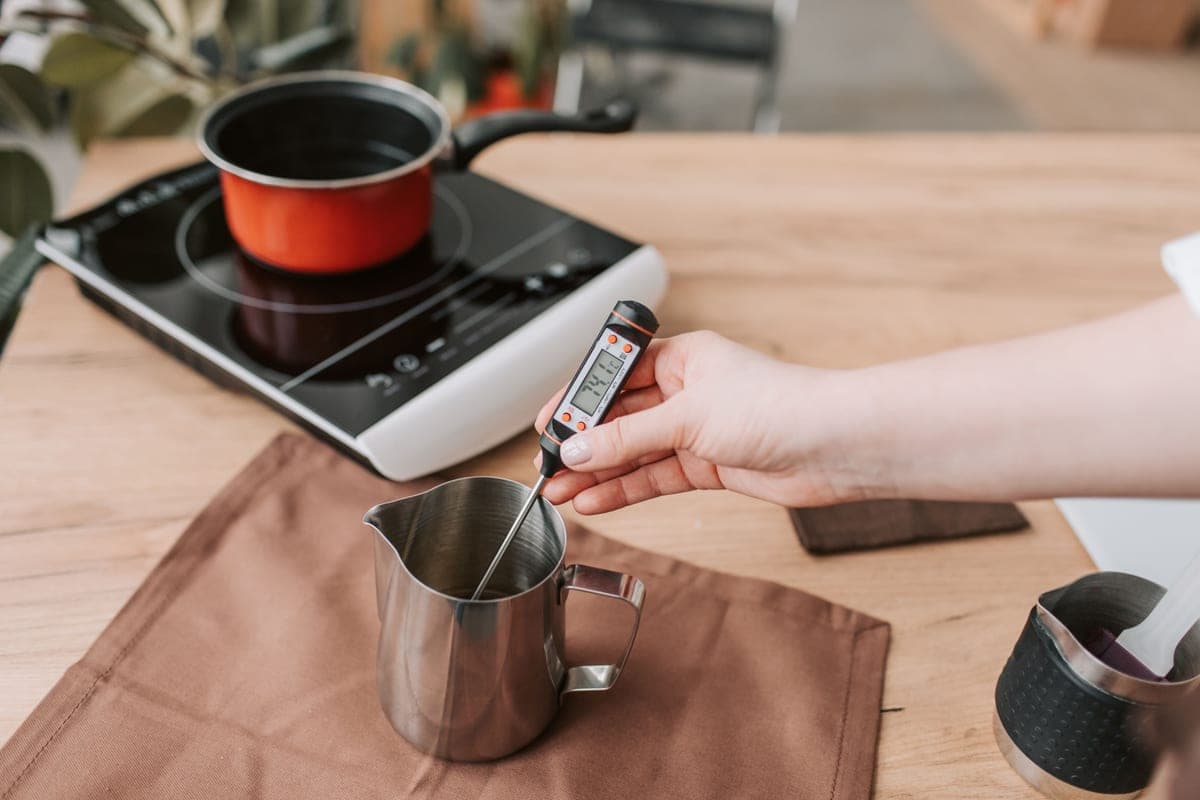
Buy one that reads at least 1,000 F, with adjustable emissivity. The Etekcity 1080 reads to 1,130 F and the 800 reads to 1,382 F with a tighter 16:1 measurement cone. Anything topping out at 716 F or 750 F is below your oven's working temperature and will simply refuse to give you a number.
Why you need one at all
Your oven's built-in dial thermometer, if it has one, measures air temperature somewhere near the roof of the chamber. Your pizza does not touch that air in any meaningful way — it sits on the stone, and the stone cooks the base by conduction.
Those two temperatures diverge, sometimes by well over 100 F, and they diverge most during preheat: the air comes up quickly, the ceramic slab underneath comes up slowly. That is why an oven can read "ready" while the floor is still 200 F short, and why the resulting pizza comes out pale and dry with a perfectly browned top.
An infrared thermometer measures a surface, which is exactly the thing you want to know. It is the accessory that most directly changes results, and it costs a fraction of the digital gauges built into premium ovens.
The range specification, and the trap
Pizza stones operate between roughly 700 and 950 F. A thermometer must clear that with margin, which in practice means a ceiling of at least 1,000 F.
The trap is that the most-bought infrared thermometers are rated for kitchen and HVAC work, where 716 F or 750 F is plenty. They are well made, cheap and highly reviewed — by people using them for griddles. Point one at a pizza stone at 880 F and it displays an out-of-range indicator, with no explanation. It does not warn you at purchase and it will not warn you in use.
Quick picks
Ranked for fit, not for hype. Every figure below is the maker’s own published number, and “n/p” means they do not publish it — which is itself worth knowing. Tap a row for the full write-up, or go straight to the listing.
| # | Oven | Best for | Max pizza | Weight | Price |
|---|---|---|---|---|---|
| 1 |  Etekcity 1080Reads to 1130 F with adjustable emissivity. | Reading a stone that is actually at 900 F | n/p | n/p | $24.99 · Check on Amazon |
| 2 |  Etekcity 800Reads to 1382 F with a 16:1 distance-to-spot ratio. | The widest margin over your oven | n/p | n/p | $28.99 · Check on Amazon |
Max pizza and weight are the makers’ published figures, sourced on each write-up below. Neither is a measurement we took, and no column here is a score — we have not cooked on these ovens and will not pretend otherwise.
Top pick · Reading a stone that is actually at 900 F
Etekcity Lasergrip 1080 Infrared Thermometer
Etekcity · Accessory
Reads to 1130 F with adjustable emissivity. The range matters: a thermometer that stops at 750 F cannot tell you anything useful about a pizza oven floor.
Published specification
- Range
- -58 F to 1130 F
- Emissivity
- Adjustable, 0.1 to 1.0
- Distance-to-spot
- 12:1
- Not for
- Measuring people
What it does well
- 1130 F clears a 950 F stone with margin, which is the only spec that matters here
- Adjustable emissivity is what lets it read dark cordierite accurately rather than defaulting to 0.95 and being wrong
- 12:1 means a usable reading from about 14 in — outside the oven mouth, not inside it
What you give up
- Infrared reads a surface, never an air temperature. The number is your stone, not your oven
- A 12:1 cone averages a wide patch at distance, so stand close and read the center
- Cheap infrared units drift; treat it as a repeatable relative reading, not a laboratory value
Buy it if
Every oven without a built-in stone-temperature readout, which is most of them.
Skip it if
Ovens with a digital floor probe already fitted, like the Ooni Connect hub models.
Where these numbers came from
Pick 2 · The widest margin over your oven
Etekcity Infrared Thermometer 800
Etekcity · Accessory
Reads to 1382 F with a 16:1 distance-to-spot ratio. The tighter cone is the real upgrade: a smaller measured patch means you can read the center of the stone rather than an average of it.
Published specification
- Range
- -58 F to 1382 F
- Distance-to-spot
- 16:1
- Not for
- Measuring people
What it does well
- 16:1 measures a smaller patch than a 12:1 unit at the same distance, which matters when the front and back of a stone differ by 100 F
- 1382 F means the tool is never the limiting factor, including on a wood fire's floor
- Same adjustable-emissivity family as the 1080
What you give up
- The extra range above about 1000 F is headroom you will never use on a pizza stone
- Still a surface reading, with all the same caveats
Buy it if
Wood-fired cooks and anyone mapping hot and cold spots across a large stone.
Skip it if
A buyer for whom the 1080 is cheaper — the difference is marginal for gas ovens.
Where these numbers came from
What we would skip, and why
A roundup that recommends everything recommends nothing. These are on the shelf next to the picks above, and here is why they are not on the list.
Etekcity 749
A perfectly good thermometer with a 716 F ceiling. Every gas oven on this site operates above that, so it will show an out-of-range indicator at exactly the moment you need a reading. It is genuinely useful for griddles and pans — it is simply the wrong tool here, and it is the single most common mis-purchase in this category.
Emissivity: the setting that makes the number right
Infrared thermometers work by reading emitted radiation, and different materials emit differently at the same temperature. Emissivity is the correction factor for that, on a scale of 0 to 1.
Cheap fixed-emissivity units assume 0.95, which suits many matte surfaces and is wrong for others — shiny metal in particular reads dramatically low. Adjustable emissivity lets you set the correct value for dark cordierite, which is what your stone actually is.
In practice, precision matters less than consistency. Set it once, use the same setting every time, and learn what a good bake looks like at your reading. A repeatable number you understand beats a theoretically correct one you cannot reproduce.
Distance-to-spot ratio
A 12:1 ratio means that at 12 in the tool averages the temperature over a 1 in circle; at 24 in, over a 2 in circle. A 16:1 unit measures a tighter spot at the same distance.
That matters because a stone is not uniform. The area under a rear burner can be a hundred degrees hotter than the front lip, and a wide averaged reading hides exactly the variation you want to see. Stand close, read the center, then read the front and the back separately — the difference between those numbers tells you how much turning the pizza will need.
How to use it properly
- Measure the stone, not the air. Point it at the floor where the pizza will sit.
- Measure from outside the mouth. These tools are not built to be waved inside a 900 F chamber, and neither is your hand.
- Take three readings — front, center, back. The spread tells you where the hot spot is, and therefore which way and how often to turn.
- Re-measure between pizzas. A stone that has dropped 150 F after two bakes is telling you to wait rather than to launch. This is the number that fixes the recovery problem.
- Never point it at a person. These are marked not for human use for a reason — skin emissivity differs and the reading is meaningless.
How these picks were made
We did not cook on these ovens. Every figure on this page is the maker’s or the listing’s published specification, cited on each write-up so you can check it in one click. The ranking comes from matching those published capabilities to a stated use case — space, pizza size, fuel, and how many pizzas you cook in a row. Where a maker does not publish a number, we say so instead of estimating one.
The full version of that argument, including what we deliberately do not claim, is on our methodology page.