Peels, stones and tools
Pizza stones and steels: which belongs in which oven
Steel conducts heat into dough far faster than stone. That is exactly what you want at 550 degrees and exactly what ruins a base at 900.
The short answer
Steel for a domestic oven, cordierite for a pizza oven. Steel moves stored heat into dough much faster, which rescues a base in a 550 F kitchen oven and scorches one in a 900 F pizza oven. In a pizza oven, the variable that matters is thickness: 0.4 in floors need a recovery pause, 0.67 to 0.8 in floors do not.
What the two materials actually do differently
Both store heat and give it to the dough. They differ in how fast they give it up.
Steel conducts quickly. It dumps its stored energy into the base rapidly, producing fast browning. In a domestic oven that is exactly the rescue you need, because the oven's 500 to 550 F ceiling would otherwise leave you with a pale, slowly drying base.
Cordierite conducts more slowly and is porous. The slower transfer suits high temperatures, where a fast-conducting surface would burn the base before the top set. The porosity pulls moisture out of the dough, which is the other half of a crisp base.
Which is why the recommendation inverts with oven temperature. Put a steel in a 900 F pizza oven and you get a scorched, bitter base under raw toppings.
Thickness: the number that governs recovery
The floors in the ovens on this site range from 0.4 in (Ooni Volt 2) to 0.8 in (Gozney Arc XL, Ooni Koda 2 Pro and Koda 2 Max). That factor of two is stored energy, and stored energy is what cooks the second, third and fourth pizzas.
The trade is preheat. More mass takes longer to bring up to temperature — a thicker stone is slower to be ready and slower to fade. If you cook one pizza at a time, thin is arguably better. If you feed a table, thickness is the specification to buy on, and a thicker replacement stone is one of the few upgrades that genuinely changes how an oven behaves.
Quick picks
Ranked for fit, not for hype. Every figure below is the maker’s own published number, and “n/p” means they do not publish it — which is itself worth knowing. Tap a row for the full write-up, or go straight to the listing.
| # | Oven | Best for | Max pizza | Weight | Price |
|---|---|---|---|---|---|
| 1 | 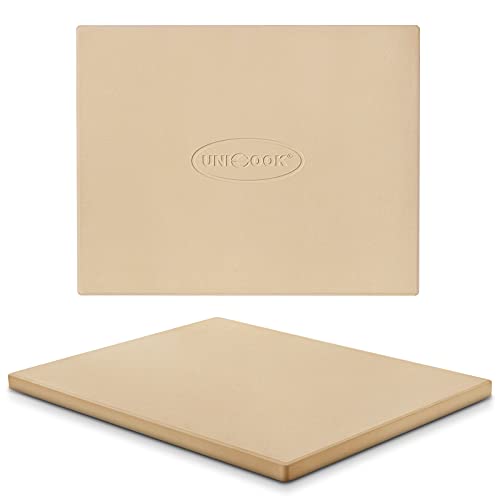 Unicook cordierite stone6.8 lb of cordierite, rectangular so it uses the whole rack. | The kitchen oven you already own | 12" | 6.8 lb | $29.99 · Check on Amazon-9% |
| 2 | 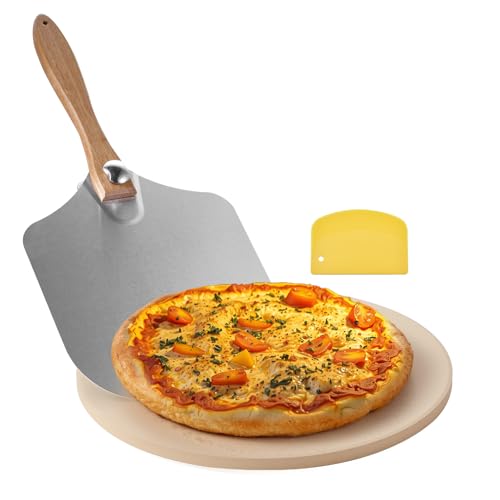 VEVOR 15 in stone0.67 in of cordierite rated to 1450 F. | A thicker replacement floor | 14" | n/p | $38.90 · Check on Amazon |
| 3 |  VEVOR pizza steelSteel moves heat into dough far faster than stone does, which is why a steel in a 550 F kitchen oven browns a base th... | Browning a base in a domestic oven | 12" | n/p | $84.90 · Check on Amazon |
Max pizza and weight are the makers’ published figures, sourced on each write-up below. Neither is a measurement we took, and no column here is a score — we have not cooked on these ovens and will not pretend otherwise.
Top pick · The kitchen oven you already own
Unicook 15 x 12 in Rectangular Cordierite Pizza Stone
Unicook · Accessory
6.8 lb of cordierite, rectangular so it uses the whole rack. For anyone not ready to buy an oven, this plus a hot domestic oven is the cheapest real improvement available.
Published specification
- Size
- 15 x 12 in rectangular
- Weight
- 6.8 lb
- Material
- Cordierite
- Included
- Dough scraper
What it does well
- Rectangular beats round in a domestic oven — a round stone wastes the corners of a rack
- Cordierite is porous, so it pulls moisture out of the base, which is exactly the failure mode of a domestic-oven pizza
- 6.8 lb of stored heat is the difference between a pale base and a browned one
What you give up
- A domestic oven caps out around 500 to 550 F, so no stone makes it a pizza oven. See why oven temperature is the whole game
- Cordierite is thermally shock-sensitive: it goes in a cold oven and heats with it, never onto a hot one
- Needs a long preheat — 45 minutes to an hour to be genuinely useful
Buy it if
Anyone deciding whether they care enough about pizza to buy an oven.
Skip it if
Someone who already owns a 950 F oven with a stone in it.
Where these numbers came from
Pick 2 · A thicker replacement floor
VEVOR 15 in Round Cordierite Baking Stone
VEVOR · Accessory
0.67 in of cordierite rated to 1450 F. Thicker than the 0.4 to 0.6 in floors in several ovens on this site, which is the specification that most affects recovery between pizzas.
Published specification
- Size
- 15 in round
- Thickness
- 0.67 in
- Heat rating
- 1450 F
- Included
- Metal peel and scraper
What it does well
- 0.67 in stores meaningfully more heat than a 0.4 in floor, and stored floor heat is what cooks the base
- 1450 F rating is well clear of any oven here
- Cheap enough to be the sacrificial floor you crack instead of the one that came with the oven
What you give up
- Round, so it wastes rack space in a domestic oven where rectangular would not
- A thicker stone takes longer to preheat — you trade recovery time for warm-up time
- Check your oven's own floor recess before assuming a 15 in round drops in
Buy it if
Replacing a cracked stone, or thickening a thin factory floor.
Skip it if
A domestic oven, where a rectangular stone or a steel uses the space better.
Where these numbers came from
Pick 3 · Browning a base in a domestic oven
VEVOR Pre-Seasoned Carbon Steel Pizza Steel, 3/8 in
VEVOR · Accessory
Steel moves heat into dough far faster than stone does, which is why a steel in a 550 F kitchen oven browns a base that a stone leaves pale.
Published specification
- Size
- 20" x 14" x 3/8"
- Material
- Pre-seasoned solid carbon steel
What it does well
- Steel's conductivity is the reason it out-browns cordierite in a domestic oven — it delivers stored heat into the dough faster
- Pre-seasoned, so it arrives usable
- Effectively unbreakable, unlike a stone
What you give up
- Rusts. It needs drying and oiling like a cast-iron pan
- That same fast heat transfer will scorch a base in an actual pizza oven — steel is a domestic-oven tool, not a 950 F one
- 3/8 in of steel is heavy, and at 20 in long this plate is deeper than some racks — measure before you order, and be careful lifting it in and out hot
Buy it if
A domestic-oven cook chasing a browner base.
Skip it if
Anyone putting it in a real pizza oven. Use the cordierite stone that came with it.
Where these numbers came from
If you do not own a pizza oven yet
A stone or a steel in your kitchen oven is the cheapest meaningful improvement available, and it is a good way to find out whether you care enough to buy an oven. Preheat it for 45 minutes to an hour — far longer than feels reasonable — because an unheated slab is worse than no slab.
Rectangular beats round in a domestic oven, because a round stone wastes the corners of a rack. And be clear about the limit: no accessory raises your oven's 550 F ceiling, which is the entire reason dedicated ovens exist. Pizza oven vs regular oven works through exactly how much of the gap a steel closes, and which part of it stays open.
Looking after them
- Cordierite is thermal-shock sensitive. It goes into a cold oven and heats with it. Never onto a hot floor, and never wet — trapped moisture flashing to steam is the main way these stones crack.
- Never wash a stone with soap. It is porous and it will absorb it. Brush it, scrape it, and let a hot burn-off clear the rest.
- Steel rusts. Dry it and oil it lightly like a cast-iron pan.
- Discoloration is normal. A stone that has gone brown and blotchy is a seasoned stone, not a dirty one. Do not try to restore it to new.
- Store dry. A stone that absorbs water over a winter and is then taken to 900 F is a stone with a crack in it — see winter storage.
One case this page does not cover is a stone on a barbecue. A grill heats a slab from one side and much harder than an oven does, which changes both the shape and the heat rating you want — the best pizza stones for a grill, kamado or smoker works through that, including a very well-known stone whose maker rates it below what a grill actually reaches. If you want a roof over the pizza as well as a floor, that is a grill-top conversion.
The other way to change what a pizza sits on is to put something on top of the stone. Pizza screens and pans covers when that is worth doing — pan styles, a dough too wet to launch, frozen pizza — and the specification that decides it, which is the coating: an ordinary nonstick pan publishes a 450 F ceiling against ovens that publish 950 F.
How these picks were made
We did not cook on these ovens. Every figure on this page is the maker’s or the listing’s published specification, cited on each write-up so you can check it in one click. The ranking comes from matching those published capabilities to a stated use case — space, pizza size, fuel, and how many pizzas you cook in a row. Where a maker does not publish a number, we say so instead of estimating one.
The full version of that argument, including what we deliberately do not claim, is on our methodology page.