Peels, stones and tools
Pizza screens and pans: what belongs in a 950 F oven
Every page on this site argues for baking straight onto hot stone. A screen or a pan deliberately breaks that, which is sometimes exactly right and usually not. The deciding specification is the coating.
The short answer
In a real pizza oven, use bare aluminum. A 14 in seamless aluminum screen has no coating to degrade and solves the launching problem for a few dollars. For pan styles, a LloydPans PSTK pan — the release finish is published as PTFE and PFOA free, which is a different chemistry from ordinary nonstick. And the rule that decides the rest: an ordinary nonstick perforated pan publishes 450 F, and the ovens on this site publish 700 to 950 F. That is not a margin, it is a different appliance.
Start from the awkward part. This site spends most of its pages arguing that the floor is what cooks a pizza, and that stone thickness and stone temperature are the specifications worth buying on. A screen or a pan puts a sheet of metal between the dough and that floor. It is, on purpose, a worse way to cook a pizza — so the only interesting question is when the trade is worth making.
How we judged these, before the ranking
We have not used any of them. There is no test kitchen here and no page claims one. What follows is each item's published detail matched against the temperature the reader's oven actually runs at, with the source on every figure. Three criteria, in this order:
- Does the coating survive the oven you own? This is the whole ranking. A coating is the only part of a screen or a pan with a temperature limit, and the limits vary by hundreds of degrees.
- Does the maker publish that limit at all? One product here publishes a number. One publishes its coating chemistry. The rest publish neither.
- Does the shape match a style you actually cook? A solid deep pan is not a worse screen — it is a different tool, and it exists because Detroit and Sicilian pizza are made in it.
The coating is the specification
Ordinary nonstick bakeware is coated in PTFE, and PTFE has a working ceiling. The pan on this page that publishes a figure — GoodCook's AirPerfect — states 450 F. Now put that next to what the ovens on this site publish.
| Item or oven | Published figure | Source |
|---|---|---|
| GoodCook AirPerfect nonstick pan | 450 F maximum | GoodCook |
| Winco seamless aluminum screen | Uncoated — no coating to rate | Winco, material only |
| LloydPans PSTK finish | PTFE and PFOA free; no temperature published | LloydPans |
| Domestic kitchen oven | 500 to 550 F | This site's regular oven comparison |
| Indoor electric pizza ovens | 700 to 850 F | Ooni, Ninja, Breville, Chefman, Cuisinart |
| Outdoor gas pizza ovens | 950 F | Ooni, Gozney, Solo Stove, HALO |
Published maximum temperature against published oven temperature. Every figure is the maker's own.
LloydPans is the interesting case. It publishes that its PSTK release finish is water-based, and PTFE and PFOA free — which is a statement about chemistry rather than a temperature. What it does not publish, on any page we could read, is a maximum oven temperature. So the honest position is: the chemistry behind the 450 F ceiling is explicitly not what is on these pans, and the number itself is not stated. That is better than most of this category manages and it is not the same as a published rating.
A screen and a pan do opposite things
They get shelved together and searched for together, and they are not variants of one product.
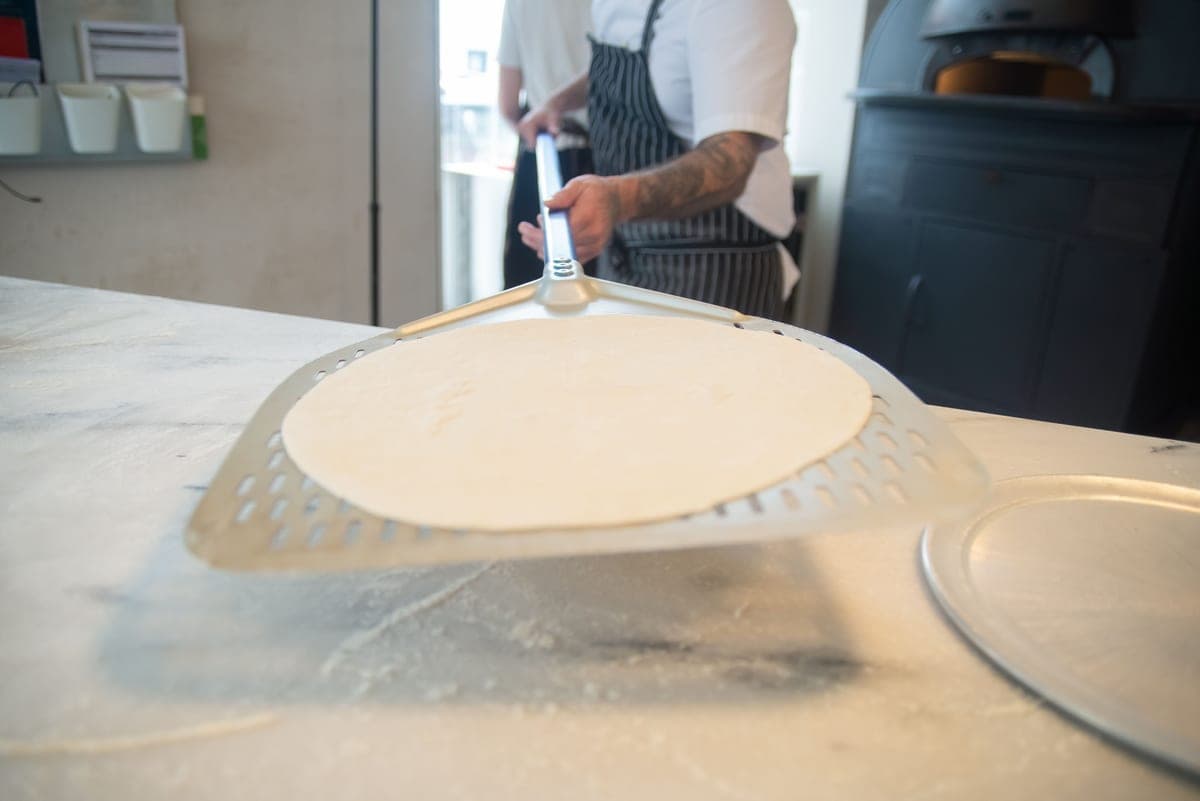
A screen is mostly holes. It is a carrier. Hot air still reaches the underside of the dough through the mesh, so the base browns — less than it would on bare stone, but it browns. A screen is the answer to a launching problem, not a cooking one, and plenty of pizzerias use them for exactly that.
A pan is solid. It blocks the stone completely and becomes the cooking surface itself. That sounds like a downgrade and for a thin round it is. For Detroit, Sicilian, Grandma and Chicago styles it is the entire point: the dough proves in the pan, the cheese goes to the metal edge, and the caramelized rim that forms against the hot wall is the thing you were trying to make.
Four reasons to use one, and one reason not to
The default answer is bake on the stone. Override it when:
- You are making a pan style. Detroit, Sicilian, Grandma, Chicago. The pan is the recipe, and Neapolitan or New York at home sets out why a 950 F oven is the wrong tool for these and a pan is the fix.
- Your pizzas stick to the peel. A screen removes the launch entirely — build on the screen, slide the screen in. It is a far cheaper fix than a better peel, though a well-built peel is the better long-term answer.
- The dough is too wet or too large to launch. High-hydration dough is the most common cause of a pizza that folds on the way off the peel.
- You are reheating or cooking frozen. Frozen pizza is formulated for 400 to 425 F and a perforated pan in a domestic oven is genuinely the right tool for it.
And the reason not to: you lose base heat. The floor is the part of the oven doing the work on a thin pizza, and a sheet of metal between it and the dough slows that transfer. If a browned, blistered base is what you are chasing, a stone or a steel with nothing on top of it is the answer and always will be.
Quick picks
Ranked for fit, not for hype. Every figure below is the maker’s own published number, and “n/p” means they do not publish it — which is itself worth knowing. Tap a row for the full write-up, or go straight to the listing.
| # | Oven | Best for | Max pizza | Weight | Price |
|---|---|---|---|---|---|
| 1 |  Winco 14 in screenBare uncoated aluminum mesh, which is the whole argument. | Launching without a peel, at any temperature | 14" | n/p | $9.74 · Check on Amazon |
| 2 |  LloydPans Detroit 10x14The pan a Detroit pizza is defined by: 2.5 in straight sides that hold cheese against hot metal until it caramelizes... | Detroit style, where the pan is the recipe | n/p | n/p | $40.54 · Check on Amazon-6% |
| 3 |  LloydPans 12 in panA 1 in wall is the difference between a pan pizza and a flat one, and 12 in round is the size that actually fits the... | Pan pizza in a round oven | 12" | n/p | $31.99 · Check on Amazon |
| 4 |  GoodCook AirPerfect 14 inThe right tool for the appliance it was specified for. | A 450 F kitchen oven, and nothing hotter | 14" | n/p | $14.99 · Check on Amazon |
Max pizza and weight are the makers’ published figures, sourced on each write-up below. Neither is a measurement we took, and no column here is a score — we have not cooked on these ovens and will not pretend otherwise.
Top pick · Launching without a peel, at any temperature
Winco APZS-14 14" Seamless Aluminum Pizza Screen
Winco · Accessory
Bare uncoated aluminum mesh, which is the whole argument. There is no coating on it to degrade, so unlike every nonstick pan in this category it has no published temperature ceiling to breach.
Published specification
- Size
- 14" diameter, 0.1" thick
- Material
- Seamless aluminum, uncoated
- Construction
- Seamless frame with a reinforced edge
- Base
- Open mesh, for airflow to the underside
- Intended for
- Conveyor and deck ovens, per Winco
- Maximum temperature
- Not published — there is no coating to rate
What it does well
- Uncoated aluminum has nothing to lose at temperature. The nonstick pans in this category publish a 450 F ceiling; a bare screen does not have that failure mode
- The mesh leaves the base exposed to moving hot air, so a screen crisps where a solid pan steams
- It is the cheapest fix for the single hardest part of home pizza — getting the raw pizza off the peel without wrecking it
- Foodservice-grade with a reinforced edge, which is what stops a thin screen warping after a few dozen bakes
What you give up
- It still costs you base heat. Any metal between dough and stone slows the transfer that produces a browned base — the screen is a compromise, not an upgrade
- The mesh prints a grid onto the underside of the crust. Harmless, and visible
- A 14 in screen needs a stone wider than 14 in, which rules it out of most 12 in ovens
- Winco publishes no temperature rating at all — we are inferring from the material rather than reading a figure
Buy it if
Anyone whose pizzas stick to the peel, or who is cooking a dough too wet to launch.
Skip it if
A 12 in oven, and anyone chasing the most browned base their stone can give.
Pick 2 · Detroit style, where the pan is the recipe
LloydPans Detroit Style Pizza Pan, 10 by 14 by 2.5 in, PSTK
Lloyd Pans · Accessory
The pan a Detroit pizza is defined by: 2.5 in straight sides that hold cheese against hot metal until it caramelizes into a crust. LloydPans' release finish is water-based and published as PTFE and PFOA free, which is a different chemistry from the 450 F nonstick pans.
Published specification
- Size
- 10 x 14 x 2.5 in
- Finish
- PSTK, a water-based release finish LloydPans publishes as PTFE and PFOA free
- Seasoning
- None required — the finish is baked on
- Utensils
- Metal utensil safe
- Durability claim
- Will not chip, peel or flake off, per LloydPans
- Dishwasher
- Not recommended by LloydPans, because of detergent chemistry
- Made in
- Spokane Valley, Washington, with in-house anodizing
- Maximum temperature
- Not published on any LloydPans page we could read
What it does well
- The finish is published as PTFE and PFOA free, which matters because PTFE is the chemistry behind the 450 F ceiling on ordinary nonstick pans
- 2.5 in straight sides are the actual specification of the style — cheese to the edge, against metal, is what makes the caramelized frico rim
- Metal utensil safe, which is what you need to lever a set pizza out of a deep pan
- Detroit style is the one pizza a 950 F oven is genuinely bad at, and a pan is how you make it — see Neapolitan or New York at home
What you give up
- LloydPans publishes no maximum oven temperature on any page we could read. The finish chemistry is stated; the number is not
- The most expensive item on this page by a wide margin, for a pan that makes one style
- A 10 by 14 in rectangle will not fit a 12 in round chamber, and at 2.5 in tall it will not clear a low one either
- Not dishwasher safe on LloydPans' own advice, so it is a hand-wash pan
Buy it if
Anyone who wants Detroit or Sicilian style rather than a thin round.
Skip it if
A 12 in oven, and anyone who only makes Neapolitan.
Where these numbers came from
- LloydPans — finishes page: PSTK water-based release finish is PTFE and PFOA free; in-house anodizing in Spokane Valley, Washington
- LloydPans — PSTK page: permanent stick-resistance, no pre-seasoning required, metal utensil safe, will not chip, peel or flake off
- LloydPans — FAQ: automatic dishwashers not recommended because of the caustic chemicals in dishwashing detergent
- Amazon listing — LloydPans Detroit style pizza pan 10 by 14 by 2.5 in, PSTK
Pick 3 · Pan pizza in a round oven
LloydPans Straight Sided Pizza Pan, 12 in by 1 in, PSTK
Lloyd Pans · Accessory
A 1 in wall is the difference between a pan pizza and a flat one, and 12 in round is the size that actually fits the ovens on this site. Same PTFE-free PSTK finish as the Detroit pan, at a lower price.
Published specification
- Size
- 12 in round, 1 in deep
- Finish
- PSTK, published by LloydPans as PTFE and PFOA free
- Seasoning
- None required
- Utensils
- Metal utensil safe
- Dishwasher
- Not recommended by LloydPans
- Maximum temperature
- Not published
What it does well
- 12 in round is the one pan shape that fits most ovens here, where the rectangular Detroit pan does not
- A 1 in straight side gives you a pan crust and a defined edge without committing to a 2.5 in deep dish
- The same published PTFE- and PFOA-free release finish as the deeper pans
- Cheaper than the Detroit pan and far more versatile — it will also take focaccia and a deep-ish round
What you give up
- No published temperature rating, same as the rest of the LloydPans range
- A 1 in wall is not enough for a true Detroit frico edge; that wants the 2.5 in pan
- Still a solid pan, so the stone underneath it is doing nothing but holding it up
- Hand wash only on the maker's advice
Buy it if
Someone who wants pan pizza out of the round oven they already own.
Skip it if
Detroit style, and anyone baking directly on stone.
Pick 4 · A 450 F kitchen oven, and nothing hotter
GoodCook AirPerfect 14 in Insulated Nonstick Perforated Pizza Pan
GoodCook · Accessory
The right tool for the appliance it was specified for. GoodCook publishes 450 F, which covers a domestic oven and frozen pizza comfortably, and is 250 to 500 F below every pizza oven on this site.
Published specification
- Size
- 14 in round, perforated
- Material
- Insulated carbon steel with a nonstick coating
- Maximum temperature
- 450 F, per GoodCook
- Utensils
- No metal utensils — nylon, silicone or wood
- Dishwasher
- Dishwasher safe
- Extras
- Cutting guides pressed into the base
What it does well
- Publishes a maximum temperature, which almost nothing else in this group does, and 450 F is honest about what a nonstick coating can take
- Perforations let some air reach the base, so it browns better than a solid tray in a domestic oven
- Insulated construction is aimed squarely at the burnt-bottom problem in a home oven
- Dishwasher safe, which neither LloydPans pan is
What you give up
- 450 F is not a pizza-oven pan. Ovens on this site publish 700 to 950 F; putting this in one takes the coating far past its rated range
- No metal utensils, which is awkward on a pan you have to lever a pizza out of
- Nonstick coatings are consumable — this is a pan you replace, not one you keep
- In a domestic oven, a stone or a steel will still out-brown it, because a pan is metal between the dough and the heat
Buy it if
A domestic oven at 400 to 450 F, frozen pizza and reheats.
Skip it if
Any outdoor pizza oven, and any indoor oven on this site — all of them run past its rating.
Sizing: the screen must be smaller than the stone
Two constraints, and both catch people out.
A screen has to sit inside the stone with air moving round it. A 14 in screen wants a stone wider than 14 in, which rules it out of every 12 in oven on this site. If you own a 12 in oven, a 12 in screen is the largest that makes sense and it does not leave much pizza.
A pan has to clear the chamber height, not just the floor. This is the one that gets missed. A 2.5 in Detroit pan is a tall object going into a chamber that may be only six or seven inches at the crown, and it has to go in and come out with a peel underneath it. Gozney publishes 6.8 in of internal height for the Arc and Arc XL; most makers publish nothing at all. If you are cooking in a grill-top box, the published chamber is 3 in and a deep pan simply will not go.
What none of them publish
Worth stating plainly, because it is most of the category. Winco publishes a material and a size but no temperature. LloydPans publishes a coating chemistry, a durability claim and care advice, but no temperature. The multipack screens publish neither. Exactly one product on this page states a number, and it is the one whose number rules it out of a pizza oven.
For a bare aluminum screen that gap is not really a problem — aluminum's melting point is far above anything an oven here reaches, and there is no coating to break down. For a coated product with no published limit, it is a genuine unknown, and this site would rather say so than estimate.
How these picks were made
We did not cook on these ovens. Every figure on this page is the maker’s or the listing’s published specification, cited on each write-up so you can check it in one click. The ranking comes from matching those published capabilities to a stated use case — space, pizza size, fuel, and how many pizzas you cook in a row. Where a maker does not publish a number, we say so instead of estimating one.
The full version of that argument, including what we deliberately do not claim, is on our methodology page.
Questions people actually ask
+Can you use a pizza screen in an Ooni or a Gozney?
+Can you put a nonstick pizza pan in a pizza oven?
+Does a pizza screen ruin the crust?
+What pan do you need for Detroit style pizza?
+Screen or pan for frozen pizza?
+Are pizza screens dishwasher safe?
Sources for this page
- GoodCook — AirPerfect bakeware: insulated nonstick carbon steel, oven safe to 450 F
- LloydPans — finishes: PSTK water-based release finish is PTFE and PFOA free; in-house anodizing, Spokane Valley, Washington
- LloydPans — PSTK: permanent stick-resistance, no pre-seasoning required, metal utensil safe, will not chip, peel or flake off
- LloydPans — FAQ: automatic dishwashers not recommended, because of the caustic chemicals in dishwashing detergent
- Winco — APZS-14 seamless aluminum pizza screen: 14 in, uncoated aluminum, reinforced edge, mesh base, for conveyor and deck ovens