Gas pizza ovens
How long a propane tank lasts in a pizza oven
The maths is simple and the inputs are the problem: almost no maker publishes a burner rating. Here is the calculation, run on the one figure that is actually published.
The short answer
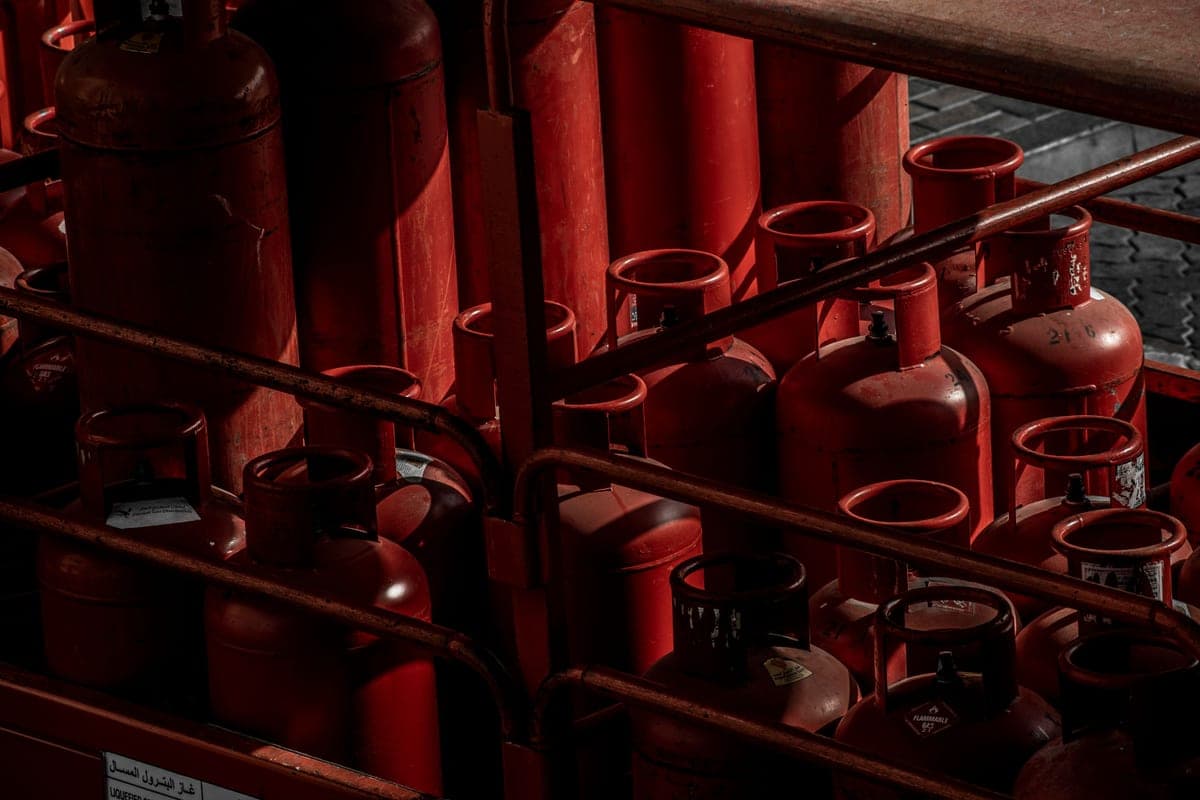
A full 20 lb propane cylinder holds roughly 430,000 BTU. Divide that by the burner's input rating and you get hours at continuous full output. For the Solo Stove Pi Prime's published 15,000 BTU that is about 28 hours in theory, and Solo Stove publishes up to 20 hours on high — a claim with sensible margin. At a realistic 45 minutes of burn per pizza evening, that is roughly 25 to 35 evenings per cylinder.
The arithmetic, in full
Propane carries approximately 21,500 BTU per pound. A standard 20 lb cylinder, filled to its safe capacity, holds about 20 lb of propane, giving roughly 430,000 BTU of usable energy. That is the numerator.
The denominator is the burner's input rating in BTU per hour. Divide and you get hours of continuous operation at full output:
| Burner input | Hours at full output | Pizza evenings at 45 min each |
|---|---|---|
| 10,000 BTU/h | 43.0 | ~57 |
| 15,000 BTU/h | 28.7 | ~38 |
| 20,000 BTU/h | 21.5 | ~28 |
| 30,000 BTU/h | 14.3 | ~19 |
Theoretical continuous-burn hours from one 20 lb cylinder, at 430,000 BTU. Only the 15,000 BTU row corresponds to a real published rating (Solo Stove Pi Prime); the others are shown to illustrate how the number moves.
Why we can only do this for one oven
Because Solo Stove is the only maker on this site that publishes a burner input rating. Ooni publishes none for the Koda line. Gozney publishes none for the Arc family or the Roccbox. Bertello publishes none. Without that number the calculation above cannot be run, and any site that runs it anyway has invented the input.
That is a genuinely annoying gap and it is worth naming, because burner rating is not a trade secret — it is on the appliance's own regulatory data plate. It simply is not carried through to the published specification.
Why your real runtime will be shorter
The table above assumes continuous operation at maximum. Real use is not that, and the deviations cut both ways.
- Preheat is full output. Twenty minutes at maximum, every session, before a single pizza. That is the largest single consumer of gas in a typical evening and it does not scale with how many pizzas you cook.
- Cooking is usually below maximum. Once at temperature, most ovens hold with the dial well down, so the per-pizza cost after preheat is small.
- Cold weather increases consumption and, below roughly 20 F, reduces the pressure a cylinder can deliver at all — a real limit on winter cooking, not just an efficiency note.
- A partially empty cylinder delivers less. As propane is drawn off, the liquid cools and vapor pressure drops, which is why the last portion of a cylinder feels weaker.
The practical rules
Own two cylinders. This is the whole answer to the runtime question. Cylinders do not have gauges you can trust and they always empty mid-cook. A second full cylinder costs less than one ruined pizza night.
Weigh, do not guess. A cylinder's tare weight is stamped on the collar as "TW" in pounds. Put the cylinder on a bathroom scale, subtract the tare, and what remains is pounds of propane. Multiply by 21,500 for BTU remaining. That is the only reliable measurement available to a home user.
Do not shorten the preheat to save gas. A stone that has not reached temperature is the direct cause of a pale, dry base — see how hot a pizza oven should be. The preheat is the gas that buys the result.
If runtime is your real concern
Then the answer is not a bigger cylinder — it is a gas line. Ooni's natural-gas variants of the Koda 16, Koda 2 Pro and Koda 2 Max remove the question permanently, and natural gas vs propane sets out which ovens can take one. The trade is that the oven stops being movable, which the built-in versus portable guide covers.
Quick picks
Ranked for fit, not for hype. Every figure below is the maker’s own published number, and “n/p” means they do not publish it — which is itself worth knowing. Tap a row for the full write-up, or go straight to the listing.
| # | Oven | Best for | Max pizza | Weight | Price |
|---|---|---|---|---|---|
| 1 |  Solo Stove Pi PrimeA demi-dome over a cordierite stone, 304 stainless throughout, and — almost uniquely here — a published 15,000 BTU bu... | The one maker that publishes its burner rating | 12" | 30 lb | $399.99 · Check on Amazon |
| 2 |  Ooni Koda 16Still the most sensible first gas oven anyone buys. | The default first oven | 16" | 40.1 lb | $498.00 · Check on Amazon-23% |
| 3 | 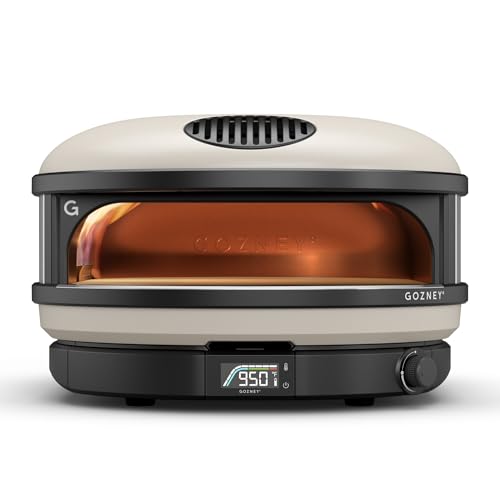 Gozney Arc XLA lateral rolling flame and two-layer insulation around a 0.8 in stone. | Heat that survives a fourth pizza | 16" | 58.5 lb | $999.99 · Check on Amazon |
Max pizza and weight are the makers’ published figures, sourced on each write-up below. Neither is a measurement we took, and no column here is a score — we have not cooked on these ovens and will not pretend otherwise.
Top pick · The one maker that publishes its burner rating
Solo Stove Pi Prime Propane Pizza Oven
Solo Stove · Propane
A demi-dome over a cordierite stone, 304 stainless throughout, and — almost uniquely here — a published 15,000 BTU burner and a published 20-hour runtime on a 20 lb cylinder.
Published specification
- Max temperature
- 950 F; about 15 minutes to preheat
- Bake time
- Listing states 90 seconds, not 60
- Opening
- 13 in wide
- Body
- 20.5 in wide x 15.5 in tall, 304 stainless steel
- Weight
- About 30 lb
- Burner
- 15,000 BTU
- Fuel runtime
- Up to 20 hours on high from a 20 lb LPG cylinder
What it does well
- Solo Stove publishes both a BTU figure and a tank runtime. Almost nobody else in this category does, and it is the reason our propane runtime guide can use real arithmetic
- The demi-dome pushes heat back down onto the pizza rather than out the front — a genuinely different shape from the flat-top Kodas
- 304 stainless rather than powder-coated carbon steel: the better material for something that lives outdoors
- About 30 lb, so it stays in the carry-it-yourself class
What you give up
- The listing's own claim is a 90-second bake, not 60. That is an honest number and it is also a slower oven
- 13 in opening means 12 in pizzas, and the stone thickness is not published
- Propane only, and the wide mouth that makes turning easy also loses heat faster on a cold evening
Buy it if
The buyer who wants to compare burners on paper before buying, and who values a stainless body outdoors.
Skip it if
Anyone who has decided 16 in is the minimum.
Where these numbers came from
Pick 2 · The default first oven
Ooni Koda 16 Propane Gas Pizza Oven
Ooni · Propane
Still the most sensible first gas oven anyone buys. 16 inches is the size where a 12-inch pizza stops feeling like a tight squeeze, and at 40 lb one person can carry it.
Published specification
- Max temperature
- 950 F (500 C), reached in about 20 minutes
- Stone
- 16 in cordierite, 0.6 in thick
- External size
- 25" L x 23.2" W x 14.7" H
- Weight
- 40.1 lb unboxed
- Fuel
- Propane, or a separate natural-gas version for a gas line
- Warranty
- 1 year standard, 5 years on registration with Ooni
- Gas input
- Ooni does not publish a BTU input rating for the Koda line
What it does well
- The 16 in stone is the real argument for this model over the 12 in ovens — a 12 in pizza sits inside it with room to turn, which is what actually stops a burnt edge
- One-piece body with folding legs: no assembly, and it is the largest oven here a single person carries comfortably
- There is a natural-gas variant, so a household with a gas line can stop buying cylinders entirely — rare in this category
What you give up
- 0.6 in stone stores less heat than the 0.8 in floors on the newer Koda 2 Pro and the Gozney Arc, so back-to-back bakes need a longer recovery pause
- Single burner across the back: no dual-zone control, so everything cooks at one temperature
- No door and no glass, so the heat you lose between launches is heat you re-earn with the flame
Buy it if
Someone buying their first serious outdoor oven who wants 16 in capacity and does not want to think about fuel beyond turning a dial.
Skip it if
Anyone who wants wood flavor, and anyone cooking two different things at once — that is the Koda 2 Pro or the Karu.
Where these numbers came from
Pick 3 · Heat that survives a fourth pizza
Gozney Arc XL Propane Outdoor Pizza Oven
Gozney · Propane
A lateral rolling flame and two-layer insulation around a 0.8 in stone. The Arc XL is the 16 in oven built around heat retention rather than around portability, and it shows on the fourth bake.
Published specification
- Max temperature
- 950 F (500 C)
- External size
- W 20.9" x D 24.8" x H 13.5"
- Internal size
- W 16.8" x D 20.3" x H 6.8"
- Weight
- 58.5 lb bare, 73 lb boxed
- Stone
- Removable 0.8 in (20 mm) cordierite
- Flame
- Lateral rolling gas flame, digital temperature gauge
- Warranty
- 1 year standard, 5 years on registration within 60 days
What it does well
- The lateral flame runs along the side rather than across the back, which is why the Arc needs fewer turns than a rear-burner oven of the same size
- Dense two-layer insulation plus a 0.8 in floor is the combination that holds temperature through consecutive launches
- 6.8 in of internal height is unusually generous — it is the reason thick-rim and pan styles work here
- No assembly, and the digital gauge means you are not guessing at stone temperature
What you give up
- Gozney does not publish a gas input rating either, so burner comparisons against Solo Stove's stated 15,000 BTU are impossible on paper
- 58.5 lb with no folding legs — it moves, but not casually
- Propane only; there is no natural-gas variant of the Arc
Buy it if
Anyone who cooks more than two pizzas in a sitting and is tired of waiting for the stone to come back.
Skip it if
Buyers who want wood flavor, or who need to pack the oven into a car.
Where these numbers came from
How these picks were made
We did not cook on these ovens. Every figure on this page is the maker’s or the listing’s published specification, cited on each write-up so you can check it in one click. The ranking comes from matching those published capabilities to a stated use case — space, pizza size, fuel, and how many pizzas you cook in a row. Where a maker does not publish a number, we say so instead of estimating one.
The full version of that argument, including what we deliberately do not claim, is on our methodology page.