Choosing by space
Pizza ovens under a covered patio or pergola
This is the question people ask after buying, and it is much better asked before. A roof over the oven is not a detail — for a combustion appliance it can be the whole answer.
The short answer
Gas and wood ovens are open-flame combustion appliances — they consume oxygen and produce combustion products, and their manuals require genuine outdoor ventilation with open sky above. A solid roof, a tight awning or a low ceiling does not satisfy that. An open-slat pergola is a different case and may be fine, but the manual and the overhead clearance decide it. Where a cover rules gas out, an electric oven is the answer rather than a compromise.
What "outdoor" is actually protecting against
Two separate hazards, and people usually think about only the second.
Combustion products. A gas or wood oven burns fuel and produces exhaust, including carbon monoxide. Outdoors that disperses. Under a solid roof — especially one that traps air at the edges — it can accumulate, and carbon monoxide is odorless. This is the reason the manuals say open sky rather than merely "not indoors", and it is why a garage with the door open is still not an acceptable location.
Radiant and convected heat. The exhaust leaving a pizza oven is extremely hot, and it goes straight up. A ceiling, beam, awning fabric or soffit directly above the flue is receiving that heat continuously for the length of a session — an hour or more including preheat. Overhead clearance is the single most commonly ignored figure in the clearances guide, and it is the one most likely to scorch something structural.
Solid roof, pergola, or awning
These are three genuinely different situations and it is worth being precise about which one you have.
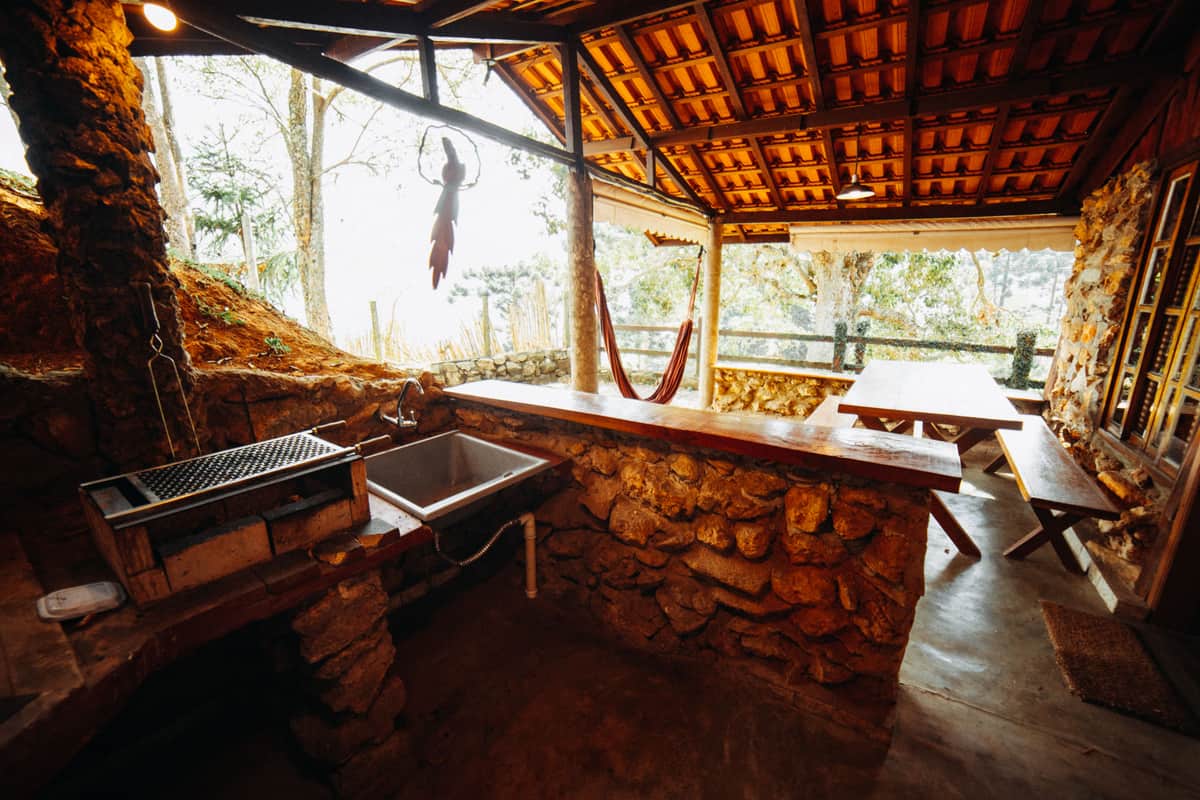
- A solid roof — a covered porch, a lean-to, a balcony with the floor above as its ceiling. This is the hardest case. There is no open sky, exhaust has nowhere to go but sideways, and the ceiling takes sustained heat. For most gas ovens this is outside what the manual permits.
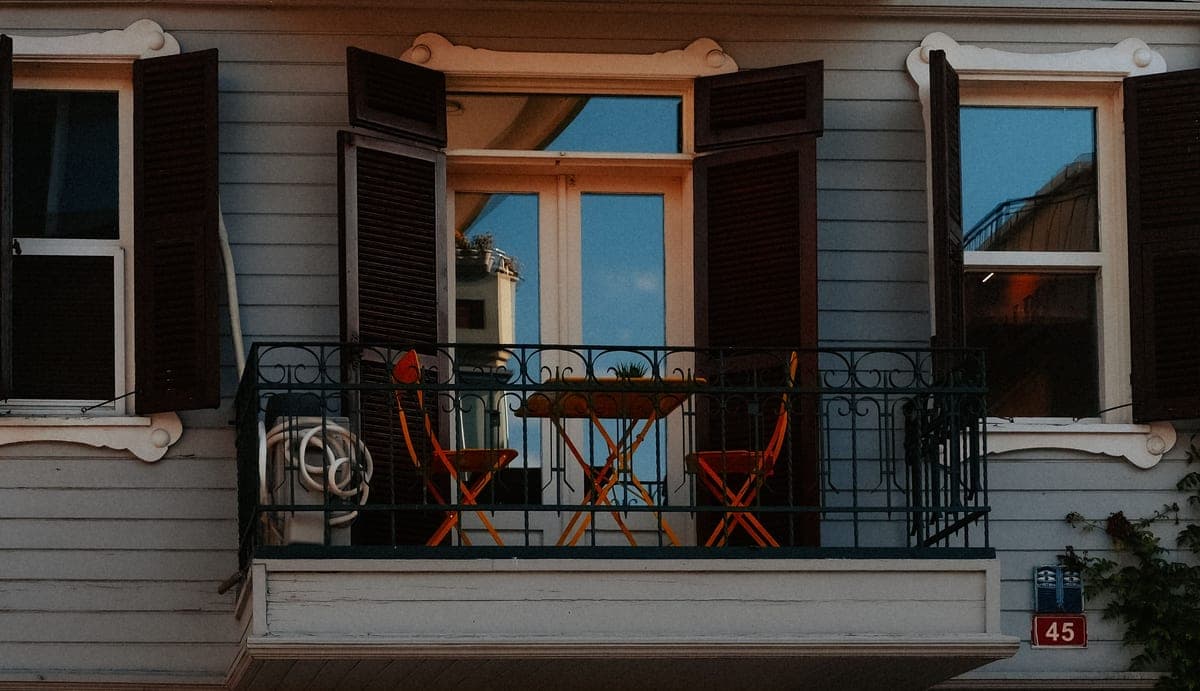
- An open-slat pergola with genuine gaps and nothing solid above is much closer to open sky, and is often acceptable — but check the clearance from the nearest beam, and remember that timber directly above a flue is the thing that chars. A retractable canopy fitted to a pergola puts you back in the solid-roof case whenever it is closed.
- A fabric awning or a patio umbrella is the worst of both: no ventilation benefit, and a combustible surface at exactly the height the exhaust reaches. Never site an oven under one.
Wood is harder than gas here
If you were considering a multi-fuel oven under cover, weigh this separately. A wood or charcoal fire produces far more visible smoke than a gas burner, and smoke under a roof has to go somewhere — usually along the ceiling and into the seating area you built the cover for.
It also produces sparks and embers on a scale gas does not, which matters when there is timber overhead. And the chimney on a wood oven puts the exhaust higher, which sounds helpful and in a covered space means it is closer to the ceiling. The fuel guide covers the trade generally; under a roof it tilts further toward gas.
The electric answer, which is a real one
If your space is covered and you are not prepared to re-site the oven, electric removes the combustion question entirely — there is no flame, no exhaust and no oxygen consumption.
Outdoors under cover: the Ninja Woodfire is an outdoor-rated electric oven with a pellet box that produces genuine wood smoke without a fire to manage. It reaches 700 F and draws 1,700 W, about 14.2 A, so it needs a 15 A outdoor circuit with nothing else running on it — that is the thing to check before anything else, and an extension cord is not an acceptable answer. See power requirements.
Indoors instead: the Ooni Volt 2 reaches 850 F on a standard 120 V outlet at 1,600 W, and is rated for indoor use. If the covered patio was only ever a way to cook when the weather is poor, an indoor oven solves that better — the argument is in indoor vs outdoor.
Quick picks
Ranked for fit, not for hype. Every figure below is the maker’s own published number, and “n/p” means they do not publish it — which is itself worth knowing. Tap a row for the full write-up, or go straight to the listing.
| # | Oven | Best for | Max pizza | Weight | Price |
|---|---|---|---|---|---|
| 1 |  Ninja Woodfire OO1011,700 W outdoors, 105 F to 700 F, and a pellet box that puts genuine wood smoke into an electric oven. | Electric outdoors, with real smoke | 12" | 32.4 lb | $287.27 · Check on Amazon-28% |
| 2 |  Ooni Volt 21600 W on a standard 120 V outlet, and 850 F on a stone floor. | 850 F on a normal kitchen outlet | 12" | 38.8 lb | $698.95 · Check on Amazon |
Max pizza and weight are the makers’ published figures, sourced on each write-up below. Neither is a measurement we took, and no column here is a score — we have not cooked on these ovens and will not pretend otherwise.
Top pick · Electric outdoors, with real smoke
Ninja Woodfire 8-in-1 Outdoor Oven (OO101)
Ninja · Electric
1,700 W outdoors, 105 F to 700 F, and a pellet box that puts genuine wood smoke into an electric oven. It is the only appliance here that bridges the electric and wood-fired arguments.
Published specification
- Power
- 1,700 W at 120 V, rated 15 A, per SharkNinja. The Amazon listing's technical details say 1,760 W
- Temperature range
- 105 F to 700 F
- Smoke
- Half a cup of pellets per cook, in a dedicated box
- Size
- 21.5" L x 18" W x 15.1" H
- Weight
- 32.4 lb
- Functions
- Eight, including pizza, smoker, roast, bake and dehydrate
- Placement
- Outdoor
What it does well
- Real wood smoke without a fire to manage — the pellet box is the honest middle ground in the wood versus gas argument
- The widest temperature range here by a distance: 105 F to 700 F covers dehydrating through pizza in one appliance
- Electric outdoors means no cylinders, no ash, and no tank runtime arithmetic
What you give up
- 1,700 W is about 14.2 A at 120 V, so it needs a 15 A circuit with nothing else running on it — under an amp of headroom. Check the outdoor circuit before buying — see power requirements
- 700 F is the lowest ceiling in this registry; the Neapolitan preset takes about 3 minutes, not 60 seconds
- It is eight appliances in one, which means it is not the best at any of them
Buy it if
A covered patio with a suitable outlet, and a cook who wants smoke flavor without tending a fire.
Skip it if
Indoors, high-temperature Neapolitan, or an outdoor circuit it has to share.
Pick 2 · 850 F on a normal kitchen outlet
Ooni Volt 2 Electric Indoor Pizza Oven
Ooni · Electric
1600 W on a standard 120 V outlet, and 850 F on a stone floor. It is the only oven here that turns a kitchen counter into something close to a pizzeria deck.
Published specification
- Power
- 120 V / 1600 W, standard North America Type B plug
- Temperature
- 70 F to 850 F (450 C)
- Stone
- Cordierite, 0.4 in (10 mm)
- External size
- 21.5" x 17.4" x 10.4"
- Opening height
- 3.6 in
- Weight
- 38.8 lb
- Body
- Powder-coated carbon steel, triple-paned tempered glass door
- Placement
- Indoor use only
What it does well
- 1600 W draws about 13.3 A, which fits inside a standard 15 A North American kitchen circuit — that is the whole reason this oven is practical. See power requirements
- A proof mode that goes down to 70 F means the same appliance proofs the dough it later bakes
- Triple-paned glass and a filtered exhaust are why this can live in a kitchen and a Koda cannot
- 850 F is roughly 300 F hotter than a domestic oven's maximum, which is the entire difference in crust
What you give up
- 0.4 in stone is the thinnest floor in this registry. Consecutive bakes need recovery time and the oven's control system spends its effort managing exactly that
- 850 F, not 950 F: a true 60-second Neapolitan is out of reach and Ooni does not claim it
- 3.6 in of opening height rules out deep pan builds
- Indoor use only, stated by Ooni — this is not an outdoor oven that also works inside
Buy it if
Apartments, winter, and anyone whose real obstacle is that the oven has to live indoors.
Skip it if
Anyone whose target is a 60-second, 950 F Neapolitan.
Where these numbers came from
What to check before you buy
- Read the overhead clearance in the manual for the specific model, and measure the actual distance from where the oven will sit to the lowest thing above it.
- Establish whether you have open sky. If the answer is no, gas is likely out regardless of clearance — confirm against the manual rather than assuming.
- Check what the ceiling is made of. Timber, painted board, vinyl and fabric all behave badly under sustained radiant heat.
- Check the local fire code and any building or tenancy rule. Structures change what is permitted, and this is separate from what the appliance manual says — the balcony and apartment guide covers how to find out.
- Then, if gas is out, price the electric option rather than trying to make a combustion appliance fit a space it was not designed for.
How these picks were made
We did not cook on these ovens. Every figure on this page is the maker’s or the listing’s published specification, cited on each write-up so you can check it in one click. The ranking comes from matching those published capabilities to a stated use case — space, pizza size, fuel, and how many pizzas you cook in a row. Where a maker does not publish a number, we say so instead of estimating one.
The full version of that argument, including what we deliberately do not claim, is on our methodology page.