Wood-fired and multi-fuel
Solo Stove Pi Fire: a pizza oven top for a fire pit you already own
Not a pizza oven in the sense the rest of this site uses the word. It is a chamber that sits on a Solo Stove fire pit, and its published stone ceiling is 300 degrees below the category.
The short answer
Buy the Pi Fire only if you already own the matching Solo Stove fire pit. It is a 19.6 lb ceramic-coated stainless chamber that sits on top of one, burning the fire beneath it, and it arrives with a carry case and high-heat gloves. The number that decides everything: the listing publishes a 650 F maximum for the stone, roughly 300 F below what the dedicated ovens on this site publish. That is a different pizza, not a slightly slower one.
This product gets searched for as a pizza oven and shelved next to them, and it is a genuinely different category of object. Worth being precise about what it is.
It is an accessory, and the fire pit is not included
The Pi Fire is a top. It sits on a Solo Stove fire pit, the fire pit provides the fuel and the heat, and the chamber shapes that heat around a pizza. Solo Stove sells a version per fire pit size, and they are not interchangeable:
- Bonfire Pi Fire — for the Bonfire fire pit. This is the one reviewed here, and the one most people mean.
- Ranger Pi Fire — for the smaller Ranger fire pit, at a much lower price.
- Yukon Pi Fire — for the largest fire pit. It was out of stock in the catalog this site links into when we checked on 27 September 2026.
If you do not own the fire pit, the honest arithmetic is that the oven plus the pit costs more than several complete ovens on this site, for a lower published stone temperature. That is the whole buying decision in one sentence.
What the listing publishes
| Specification | Published figure |
|---|---|
| Requires | A Solo Stove Bonfire fire pit, not included |
| Stone | Cordierite; the listing states a maximum of 650 F |
| Size | 16.9 in high x 19.3 in diameter |
| Weight | 19.6 lb |
| Material | Ceramic-coated stainless steel |
| Fuel | Wood, burned in the fire pit beneath it |
| In the box | Pi Fire chamber with long legs, carry case, high-heat gloves |
| Chamber temperature | Not published |
| Bake time | Not published |
Published figures. Solo Stove's own product page could not be read for this review, so the retail listing is the source and is labeled as such.
Six hundred and fifty degrees is the headline
Almost every outdoor oven on this site publishes 950 F. The Pi Fire's listing publishes a 650 F ceiling for the stone. That gap is not a detail and it is not recoverable with technique.
| Route | Published figure | What it produces |
|---|---|---|
| Domestic oven with a steel | 500 to 550 F | 8 to 12 minutes |
| Solo Stove Pi Fire | 650 F stone, per the listing | A New York style bake |
| Indoor electric ovens | 700 to 850 F | 90 seconds to 3 minutes |
| Outdoor gas and multi-fuel ovens | 950 F | 60 to 90 seconds |
Published stone or peak temperature across the routes this site covers.
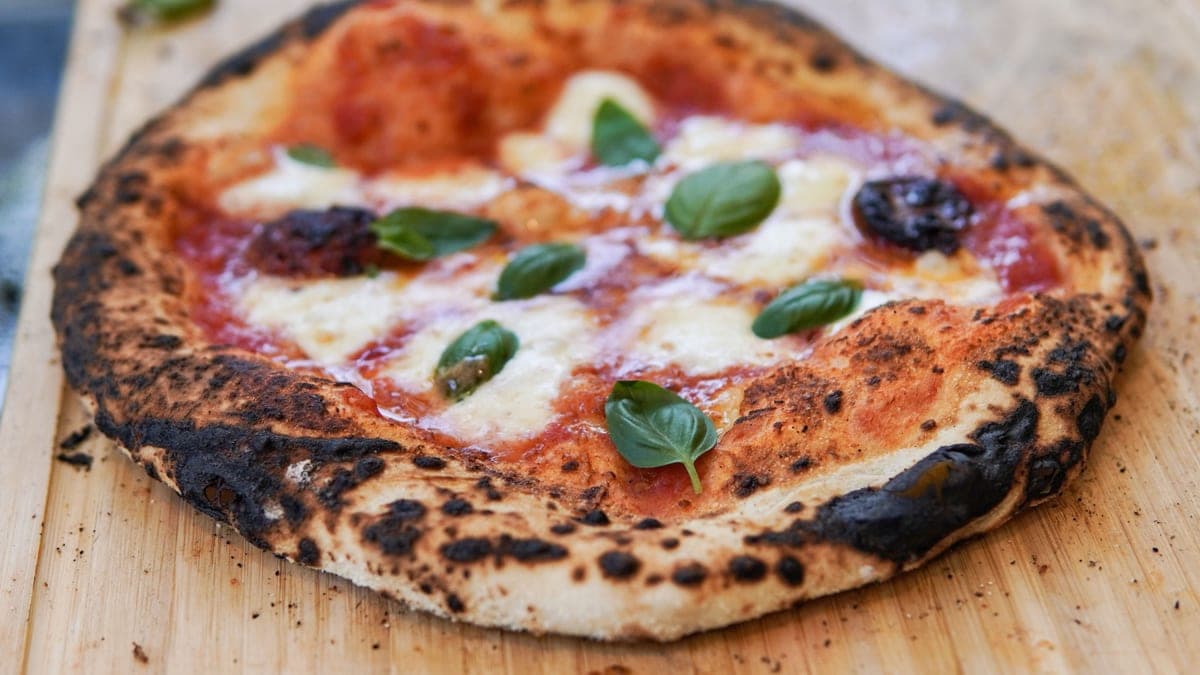
At 650 F you get a crisp, browned base and a rim that rises without charring. You do not get the leopard spotting that defines Neapolitan, because that happens to a dough skin above roughly 800 F. Neapolitan or New York at home sets out which styles live at which temperature, and the Pi Fire lives squarely in New York territory.
Quick picks
Ranked for fit, not for hype. Every figure below is the maker’s own published number, and “n/p” means they do not publish it — which is itself worth knowing. Tap a row for the full write-up, or go straight to the listing.
| # | Oven | Best for | Max pizza | Weight | Price |
|---|---|---|---|---|---|
| 1 |  Solo Stove Bonfire Pi FireA pizza-oven top for Solo Stove's Bonfire fire pit rather than a standalone oven. | Owners of a Solo Stove Bonfire fire pit | n/p | 19.6 lb | $249.99 · Check on Amazon |
Max pizza and weight are the makers’ published figures, sourced on each write-up below. Neither is a measurement we took, and no column here is a score — we have not cooked on these ovens and will not pretend otherwise.
Top pick · Owners of a Solo Stove Bonfire fire pit
Solo Stove Bonfire Pi Fire Pizza Oven Accessory
Solo Stove · Wood / charcoal
A pizza-oven top for Solo Stove's Bonfire fire pit rather than a standalone oven. If you already own the fire pit it is an easy add-on; if you do not, it is the wrong place to start.
Published specification
- Requires
- A Solo Stove Bonfire fire pit, which is not included
- Stone
- Cordierite; the listing states a maximum of 650 F
- Size
- 16.9 in high x 19.3 in diameter
- Weight
- 19.6 lb
- Fuel
- Wood, burned in the fire pit beneath it
- Material
- Ceramic-coated stainless steel
- Included
- Pi Fire oven with long legs, carry case, high-heat gloves
What it does well
- Turns a Bonfire fire pit you already own into a wood-fired pizza oven
- A carry case is included, and it goes wherever the fire pit goes
What you give up
- It needs a Solo Stove Bonfire fire pit, sold separately — on its own it does nothing
- The listing gives the stone a 650 F maximum, far below the 950 F the dedicated multi-fuel ovens publish
- The listing states a stone maximum rather than a chamber temperature, so it cannot be compared on the usual numbers
Buy it if
Someone who already owns a Bonfire fire pit and wants occasional pizza from it.
Skip it if
Anyone buying their first pizza oven.
Where these numbers came from
What it is genuinely good at
Two things, and they are real.
It turns an object you already own into two objects. A fire pit sits idle most of the time. If you have a Bonfire on the patio already, the marginal cost of adding pizza to it is one purchase and no extra footprint — which is the argument built-in or portable makes about space being the real constraint for most households.
It ships complete. A carry case and high-heat gloves in the box is more than most ovens here manage — several publish a peel and nothing else, and gloves are an accessory most buyers add later at the price of a separate purchase.
What it is not good at
Wood in a fire pit is not wood in an oven. A pizza oven's firebox is small, insulated and shaped to drive flame across a crown; a fire pit is an open cylinder optimized for a pleasant fire and a lot of secondary combustion. The Pi Fire is making the best of a heat source that was designed for something else, and the 650 F stone figure is the visible consequence.
It also inherits every part of wood-fire management with none of the aids. There is no door, no window and no built-in thermometer, so the temperature of the stone is something you infer — which is the argument for an infrared thermometer more strongly here than on any oven with a gauge.
What we cannot tell you
We have not used it. Solo Stove's own product page returned a 403 to us, so every figure above comes from the retail listing rather than the manufacturer, and that is a weaker source than this site prefers. Unresolved: the chamber temperature as distinct from the stone, how long a bake actually takes, how much wood a session consumes in the pit below, and whether the stone recovers between pizzas. None of those is published anywhere we could read.
How these picks were made
We did not cook on these ovens. Every figure on this page is the maker’s or the listing’s published specification, cited on each write-up so you can check it in one click. The ranking comes from matching those published capabilities to a stated use case — space, pizza size, fuel, and how many pizzas you cook in a row. Where a maker does not publish a number, we say so instead of estimating one.
The full version of that argument, including what we deliberately do not claim, is on our methodology page.
Questions people actually ask
+Do you need a Solo Stove fire pit for the Pi Fire?
+How hot does the Solo Stove Pi Fire get?
+Is the Pi Fire the same as the Solo Stove Pi?
+Is the Pi Fire worth it if you do not own a fire pit?
+What comes with the Solo Stove Pi Fire?
Sources for this page